January 31, 2012

ES CALO (FORMENTERA)


ES CALĂ“

Just before starting the climbing way to La Mola, we find a small fishing village on the eastern side of the island, known as Es Calo of Formentera. Here we enjoy views with the backdrop of imposing cliffs of La Mola.

Here we can enjoy small beaches of white sand in an area mainly rocky. The turquoise waters itself worth the visit...

Here is where we can find those typical and very rustic wooden docks or boathouses for the small fishing boats of the inhabitants of this area of ​​the island.


These wood buildings exists in Formentera in large numbers scattered around the coast, but perhaps here in this place is where we can find the greatest number of them. I must say that in this town we can see also some tourists and there are small family hotels, so in summer some of the tourists are mingled with locals.

It´s amazing how even after the worst windstorms these wooden dwellings have little damage, and those that exist after a major storm are rapidly repaired by the owner itself.


Here, in this place also we find the junipers that fill the island (sabinas). This tree native of the Pine Islands (Pitiusas) and that not exist in the rest of the Balearics.

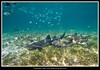
The day I visited this place I found a plague of jellyfish, but these are not at all dangerous and also completely harmless to humans. always we find them in large colonies. They navigate a sailboat in fact have a sail of them on top that make navigating and sailing vessels. In Castilian sailing jellyfish are known in their scientific name of "Velella Velella. But in english the name of this jellyfish is very clear: By-the-wind-saylor

Es Calo is a place where crowds have not reached here yet that invade the island on summer. The beaches are still unknown to most of the visitors, their transparent and turquoise waters are unique on the island and also has the charm of its sandy beaches surrounded by rocks and docks where "rest" the small fishing vessels in the area . A place to relax and enjoy nature and landscape.

January 10, 2012

IBIZA´S SHEEP


OVEJA IBICENCA (SHEEP OF IBIZA)
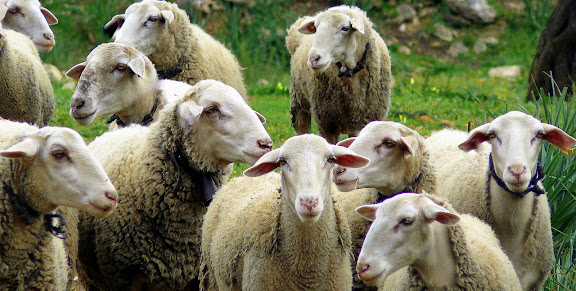
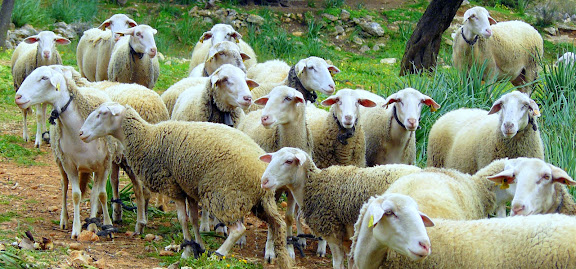
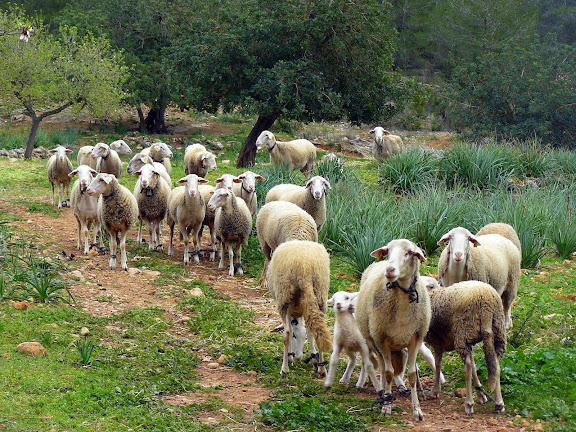
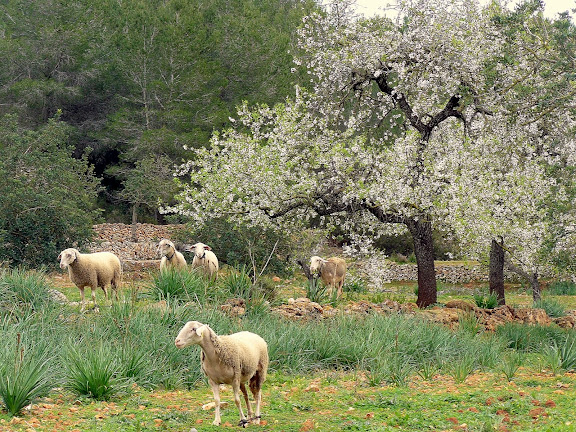
Some time ago I took these pictures, I think they are quite appropriate to start the year. They are like a postcards that everytime is more difficult to find them on Ibiza, but if we going out to the countryside and their fields we have many chances to find them. I have found these photographs left in a corner and so I have now the chance to pass a small tribute to a girl of "vila" that enjoy a lot her visits to the countryside of the island.

When I visited other Mediterranean islands such as Malta, Sicily or Sardinia I realized that sheep are different from Ibiza. It turns out that the sheep is a breed native Ibiza in the Balearic Islands. It has several characteristics, but it strikes me that the forms of their wicks are called pyramid schemes. Often with small reddish or black. Although they are generally white wool. This breed was mixed with others from others areas and the peninsula, but thanks to the breeders and its commitment to this breed, this breed of the Ibiza´s sheep has been achieved.

December 21, 2011

SEASON GREETINGS


MERRY CHRISTMAS


Its Christmas again. To all who follow this blog and who don´t, for those who have visited Ibiza and for those that will do so in the future, to those who like Christmas and to those who don´t and to those who are living near or the ones who are living far... to everyone my very best wishes for a MERRY CHRISTMAS.


BON NADAL


Just say that those pictures I chose for this entry to greet Christmas, belongs to some great pictures exposed in the Church of Santo Domingo at Dalt Vila.

December 15, 2011

ES CUBELLS DEL CARME


ES CUBELLS

One of the most spectacular villages of the island is located atop a cliff in the south of the island in an impressive semi-enclosed bay where you can see the spectacular views of the south side of the island. The small town is about this little white church of the XIXth century on the edge of the cliff and where weddings of renowned celebrities and local people as well who choose this beautiful temple as well as its wonderful enviroment to celebrates here their special day.


The sea views are stunning and many of its inhabitants are fishermen who do not have easy access to their boats because they are located down the beach where there are several very simple piers, meanwhile fishers are living on the top around the village.

On the way to the beaches down there are wonderful views that will surprise us on the way down. If important are the neighbors who are engaged in fishing is also important those above and are engaged in farming.

But the area of the cliff and the beach is the most important for those who have their boats and therefore the central axis. Es Cubells and the sea have a special relationship but totally different from other coastal towns on the island and the sea is separated by the height of the coast.

Although its beaches have no sand, but small pebbles, there is always clean water that invite us to take a bath, preferably during summer months.
Es Cubells is also famous for its spectacular mansions that exist in the descent to the coast, stunning houses with swimming pools and all the luxuries needs and no mention to the privileged views of those houses.

Es Cubells has a strange harmony between the interior Ibiza fields on its highest point of the sea and the sea in its coasts, clay cliffs and large tracts of pine trees, docks simple fishing boats and big houses ... everything has its place in this village.

Celebrities have had or still have their houses here. Ursula Andress Among them was the most popular but many others as the composer Mike Oldfield who was inspired by this place to compose his music.

Es Cubells even has its mistical side and thus recalls a sculpture next to the church dedicated to Father Palau y Quer a monk that came from the mainland, who popularized the tradition of the Virgin of Carmen that is so entrenched in this town. This hermit monk lived two stages on the island in 1864 and another at the next year.Incluso

This monk became very popular throughout the island and in Formentera, but it was in the nearby islet of Es Vedra where he spent much of his time living as a hermit and drinking from a natural fountain that exists at the top of the islet and living in one of its caves.


Back in Es Cubells one drinking fountain reminds us of another of the episodes of Father Palau over the island. Very near here put a picture in a small chapel and part of the land in this place that was dry made ​​it a small orchard.

Nowadays Es Cubells is not an isolated place as before, we can enjoy here an enviable peace and tranquility. There is also a Carmelite monastery where you can buy a palautiana route book which explains in detail the life of this religious monk. An interesting book edited by the Carmelite missionary group and I have had the pleasure to cooperate with some of the pictures that appear in the publication.

November 28, 2011

CHURCH OF SANT MATEU


SANT MATEU D´AUBARCA CHURCH


Following the aesthetic canons regarding the rural Ibiza churches, this church Sant Mateu is the strictly enforced. White walls. Although being built in the eighteenth century its use was only religious and not defensive as those of Sant Antoni, Sant Miquel, Sant Jordi and Santa Eulalia that were built much earlier and its use was defensive. A sample of its white walls is the picture above, in which case, you can see that is one of the few churches that has retained its traditional pulpit (already disappeared in many others), and which is now fully disused.

At the center of the altar, the image of Saint Matthew which is held every September 21st. On either side an image of the Virgin Mary and St. Michael. The altar has blue and gold touches. The original was destroyed and probably burned in the civil war of 1936 like many others on the island.

At the back side of the church and contrasts with the pure white walls of this little temple is a small colorful stained glass of St. Matthew, who according to the tradition was evangelist and apostle and before that tax collector, a task that has little to do with the two others. Its iconography is represented by the figure of a winged man.En

Once back to outside we see again the importance of the whitewashed walls, contrasting with black crosses, the Way of the Cross (known as via crucis) and the Calvary (set of three crosses together that exists in all rural churches of Ibiza) which are located on the porch of this church. This porch already belongs to the nineteenth century, and was vital to guard visitors and mass assistants against the bad weather before and after church services, also was an important meeting point for the population as the houses were at very far distance from one each other. This church is a small temple not for its importance but for its simplicity and beauty it is worth pausing a moment and enjoy those whitewashed walls, that one day gave the island the nickname of White Island, in addition to being located surrounded by pine trees, vines, carob trees and a large area of ​​crops typical of the island and of great natural beauty. Not forgetting the wine festival now held early in the month of December due San Mateo is one of the largest producers of both vine and wine of the island.


November 17, 2011

TWILIGHT IN SANT ANTONI


AUTUMN TWILIGHT IN SANT ANTONI DE PORTMANY

This former fishing village has undergone a brutal metamorphosis in the last 40 years. But accustomed to extreme changes also, completely changes from summer to winter offering two completely different faces. Also its image, what was the big tourist attraction and the first arrival of a respectful and polite tourists to the island by Sant Antoni in the seventies, today is the shame in many aspects of the locals and in tourism since the model is actually the model not to follow for any destination wishing a good image for itself, and (that´s the worst) with the approval of some local politicians who look the other way this big problem.


Loud noises, screaming, and drunk tourists of a part of the visitors in this town in summer are now over, and give way to a complete calm in winter and now is hard to remember the bad image of this place (well deserved in other side) that has the people. And it's not for lack of means, as Sant Antoni could be (as it already was) the best destination in Ibiza. Proof of this is the bay that is by far the most beautiful on the island. Another is its port, which along with the town skyline as seen in these images could be an idyllic vacation spot for all audiences (as was, in the past). In any event, Sant Antoni´s sunsets are unique, perhaps even better in winter than in busy summer.

November 04, 2011

MILL IN PUIG DEN VALLS


THE MILL OF PUIG D´EN VALLS

Simple architecture, as anything ancient on the island, whether churches, houses or these nice old windmills that allowed people to grind the wheat and eated bread, in times where there were more scarce goods than at present. This mill is located at the top of a "puig" (hill) just opposite the city of Ibiza which is also a hill and is the oldest part of town known as Dalt Vila.

Unlike the popular windmills of La Mancha (in the spanish mainland) these ones in Ibiza have two more poles, a total of six, like the rest of the neighboring islands, although I must say that both Ibiza and Formentera are the simplest of the Balearic Islands due the lack of housing as a larger square at its base as it happens in Mallorca and Menorca, making them much larger than these ones in Ibiza and Formentera. This discreet but beautiful mill is not used anymore from the civil war, but milling wheat from its construction even before the year 1800s.

October 31, 2011

END OF SUMMER IN CALA D´EN BASTER


AWAITING THE GOOD WEATHER IN CALA DEN BASTER

Although seems that this year will cost much more to do so, but the winter season already is here. Now days are getting shorter and longer and cold at nights are more comun, although during the day temperatures are still quite warm. The beaches and coasts are increasingly showing up again deserted and the quiet winter is appearing along the coast.

In Formentera exists a small and charming cove called Cala En Baster or Cala den Baster, I prefer the second name. There is little sand, some rocks and when the waters are calm is a good place to take a dip.

The most significant of the this creek are caves made ​​by the hand of man, especially by sailors to "park" their small fishing boats. During the summer are daily sailing the nearby waters, but when winter comes, then they hibernate in their caves, as well as those famous lizards hibernate in winter in Formentera.

The long timbers that are used to carry boats to the sea, now are falling apart with the force of the sea, the boats begin to rust, but in spring it will remove the rust that has produced winter inactivity, will be re-painting and getting ready to navigate again.

From their caves the lonely boats left here with the view of the small cliff that rises in front, which offers a unique view of the tiny bay.

A well-deserved winter break for these vessels, that will be there to save the raging sea that hits the rocks nearby, with perhaps only visit of a visitor to photograph the ocher-walled caves, carved out by wind or the owner of the boat to check that the small boat is still there awaiting for the weather to improve and again to go sailing.

October 12, 2011

A CHAPEL IN SA REVISTA (SALINAS)


SA REVISTA CHAPEL
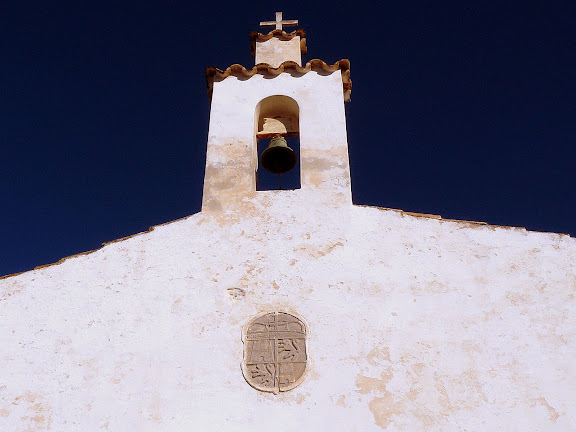
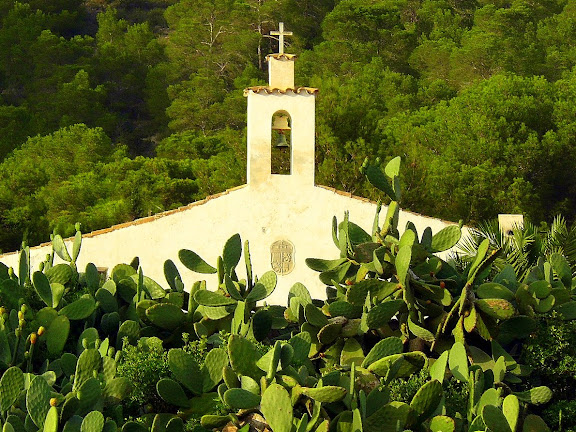
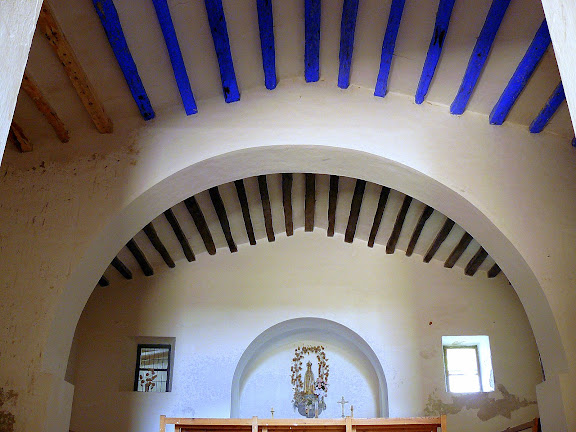
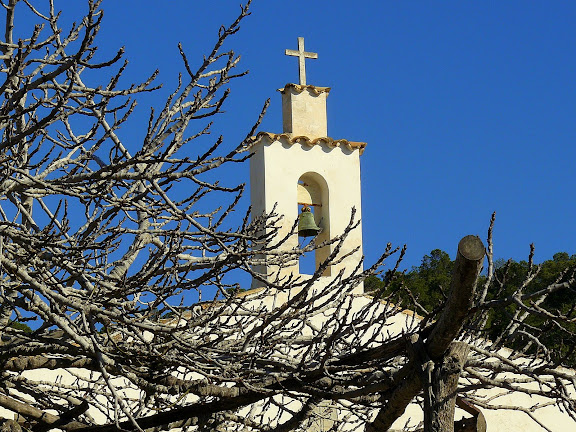
Immaculately white as all churches of Ibiza, this building was not a church but a chapel, but begun as an oratory in the eighteenth century for people working in tough conditions indeed, in the Salinas (salt flats). This chapel is very close to the beach of Es Cavallet and surrounded by nature and a few houses that form a graceful tiny village.

In the altar exists a religious image (even today when no longer is a religious building) of the Virgin of Fatima (do not know why), also ignored the curious fact that on the facade has a shield of Castile and Leon, as well as the nearby tiny church of Sant Francesc. Ibiza in the past belonged to the Kingdom of Aragon, but not to the Kingdom of Castile.

From its doors are easily visible the near salt ponds, with its distinctive flat landscape and square. The pristine white exterior of the chapel often contrasted with the deep blue Mediterranean sky and the gray trunks of the fig or prickly pear greens around the small building.


I take this entry to announce that this blog celebrates during this days the third anniversary since it was born in early October 2008. Thank you very much to all visitors, all who have commented both by mail or directly by the blog and I hope you´ll keep visiting this blog and will continue enjoying it. a big hug to all of you.