Showing posts with label CHURCHES. Show all posts

June 13, 2016

WORSHIPS AND FORTRESS ON THE PAST

FORTRESS IN THE CHURCH OF SANT ANTONI DE PORTMANY
I have already spoken before that the oldest churches of the island were originally built as temples but mainly as robust and strong fortresses, where people from the village and surrounding areas came not only for attending the holy mass but also was the place they were gathering in case of threat for moorish invasions.
Invasions came by sea, and here at the Portmany port (Portmany was the name of this bay after the conquest of the Kingdom of Aragon, and comes from its former Roman name "Portus Magnus") was an important target of those invasions of the Turkish and Arab pirates, where the invaders were attacking with mercilessly the farms, villages and especially to their inhabitants that made them their slaves. That´s why were so crucial that the church as main building had to be well defended, so that´s why its square and strong tower (the only square shaped defence tower of the island) had to hold powerful guns, as cannons that protected the population, from the barbarians incursions. 
Undoubtedly this tower located at one side of the church building is looks as that of any other castle. And this was where the population was feeling much safer on attacks. This tower dates from the sixteenth century and from there by sounding a sea conch shell, warned the population of the imminent danger of the incursions that was about to stalk people, making to everyone was running to take refuge here.
The guns had a range of about 4 kilometers, far enough to protect the harbor and able to sink any invader ship. Still at this temple we can see a moat between the bell tower down to the front door of the temple, where the population received the invaders by pouring through it, large amounts of boiling oil when they were trying to go into the temple. and of course helping this way to repel the attempted entry. Anyway the doors were made of iron, in order to prevent be burned and thus destroyed. Today the guns have not anymore the wide visibility that they had then, now great buildings surround this temple, as this town now is an important tourist resort and makes the church to be a real miniature.
Slowly, as the threat of invasions were diminishing, the temple left his defensive character to become gradually in religious and worship temple.
And then after the main steeples were built, in Sant Antoni Abad the bell tower has two bells named after Angela and Mary, the first because it was used to play the Angelus hours, meanwhile the other used to call the Mary prayer during late in the afternoon.
 For this reason in the ancient worship temples of Ibiza most of them that exercised that function do not have windows and if thick white walls (except for the tower is made of stone and was never painted white).

February 14, 2014

CHURCH OF SANT FERRAN DE SES ROQUES

CHURCH OF SAN FERNANDO
ES PUJOLS
In the main tourist resort on the island of Formentera (Es Pujols) this church that has the particularity that it is built of stone outwardly, not follow the architectural canons of being whitewashed in white, like most churches of Ibiza and Formentera due it was built with sandstone. During the Civil War as most religious buildings was severely attacked. It is the smallest of the temples of Formentera. 1.996 In was declared a Cultural Interest site.
But indoors the small temple remains in white, as these architectural rules of the Ibiza and Formentera churches are distinguished, inside the characteristic white both inside and outside the parish. On the main altar, the Image of this Saint of Seville, whom this temple is dedicated.
This parish was created in 1785 with the creation of parishes, and due to a decree regulating the creation of a third parish in Formentera, on the salt ponds (although not to be built in that area, due the weakness of the land and building was later  this church in its present location) was begun in the year 1853 although the cult began in 1889, although since 1785 the neighbors could hear the mass in a chapel dedicated to Saint John.

December 17, 2012

CHURCH OF SAN FRANCISCO IN FORMENTERA

CHURCH OF SAN FRANCISCO JAVIER IN FORMENTERA
On December 3 Formentera celebrates the feast of Saint Francis Xavier (San Francisco Javier) and the main church of Formentera is dedicated to him. Simple as the island itself, this church stands in the middle of the largest population of the small island. White walls inside this temple and architectural features as churches of the pitiusas, and very big looking outside, reminding us that, even built as a temple when the anxieties of Berber incursions were about to end, it could still have been used as a fortress against these dangerous attacks in case of need to do so.
By then, on the island there was only one place of worship, was the small chapel of Sa Tanca Vella, and early on the eighteenth century it was decided by the Archbishop of Tarragona, from which depended the churches of Ibiza and Formentera, build a large church and that was performed on the year 1726, with the collaboration of all the inhabitants of the island. The main altar we see today (pictured above) was added after the Civil War since the original was burned during the war.
The Church today is located in the middle of the main square of the town of Sant Francesc, and in front of the small council. A beautiful square which is the main meeting place for tourists and locals. A small and limed well it gives local charm, and next to it, we can see the ancient and massive defensive walls of the church.
And of course, we also see the calvary (set of three crosses that are usually at the entrance of churches of Ibiza and Formentera) at the outside white wall. Formerly the exterior walls of the church were not painted, so it had a hard aspect of a large grey building, currently whitewashed in its main facade. All this turns in a much more Mediterranean look, and it gives a especial atmosphere to all the square.

September 23, 2012

CHURCH OF SANT FRANCESC

CHURCH OF SAN FRANCISCO DE PAULA
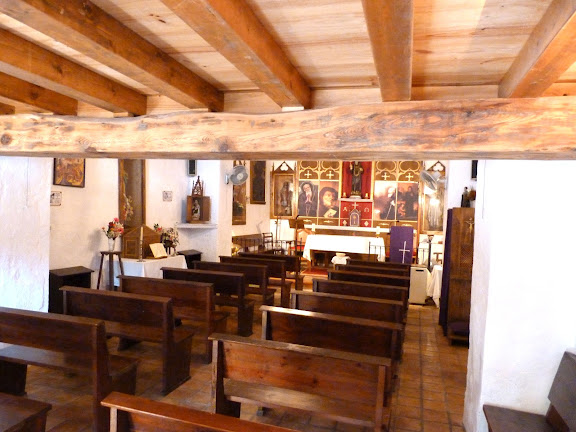
Located within the "salinas" of Ibiza, this small parish is dedicated to St. Francis of Paula, and known as Church of Sant Francesc de s'Estany or Ses Salines. Its charm lies, not only in being in one of the most spectacular places on the island, but the simplicity of the small temple. The new altar was inaugurated this year, thanks to the efforts and enthusiasm of his pastor priest, that he performed it from old photographs that exist of the former ancient altarpiece. This new altar piece added some allegorical paintings on the life of St. Francis of Paula who is dedicated this parish church.
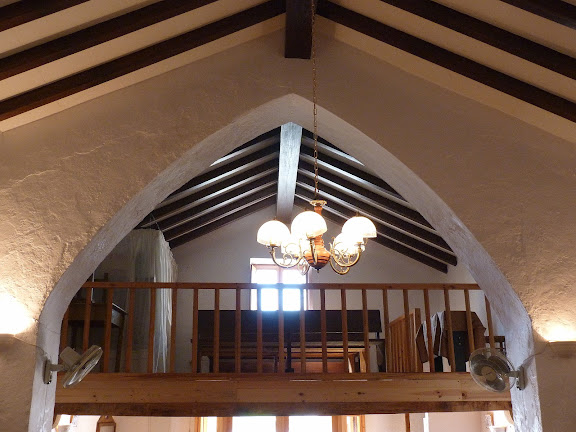
As architectural complay the fees of the Ibiza churches, should be white and simple but also it has the "honor" of being the smallest church on the island. Everything in here is small. Even paradoxically has his choir on the top floor, which are not all the churches of the island even being much bigger that have it.
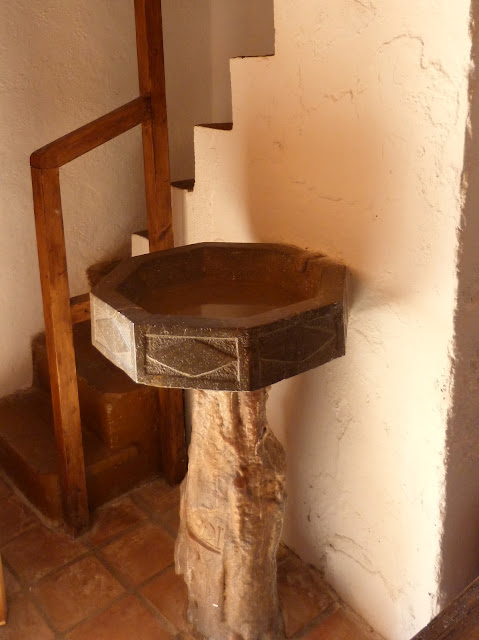
Sometimes some details are small surprises, such as the font of holy water (pictured above) which is located right next to the narrow staircase that leads to the choir. when we look at the ceiling we will see the amount of wood beams on the rustic way of typical houses (at the countryside) of the island. This church was built in the early eighteenth century. Although it is believed that was built on a previously existing chapel on the fifteenth century to meet the religious needs of the salt men who work at the near salt mines, then became a church in the year 1785.
The people of this area are very proud of their small but beautiful church, most of the religious images have been donated by some of them, and inside there are enough images that have nothing to envy in size and in numbers to the other larger churches . One of the surprising things in this temple is a shield of Castile in its facade, the reason for that, is that after the Civil War the salt mines passed to belong to the crown rights due the conquest, and the crown was responsible for the religious purposes of this place, where lived of salt workers and residents of the neighboring orchards.

November 28, 2011

CHURCH OF SANT MATEU


SANT MATEU D´AUBARCA CHURCH


Following the aesthetic canons regarding the rural Ibiza churches, this church Sant Mateu is the strictly enforced. White walls. Although being built in the eighteenth century its use was only religious and not defensive as those of Sant Antoni, Sant Miquel, Sant Jordi and Santa Eulalia that were built much earlier and its use was defensive. A sample of its white walls is the picture above, in which case, you can see that is one of the few churches that has retained its traditional pulpit (already disappeared in many others), and which is now fully disused.

At the center of the altar, the image of Saint Matthew which is held every September 21st. On either side an image of the Virgin Mary and St. Michael. The altar has blue and gold touches. The original was destroyed and probably burned in the civil war of 1936 like many others on the island.

At the back side of the church and contrasts with the pure white walls of this little temple is a small colorful stained glass of St. Matthew, who according to the tradition was evangelist and apostle and before that tax collector, a task that has little to do with the two others. Its iconography is represented by the figure of a winged man.En

Once back to outside we see again the importance of the whitewashed walls, contrasting with black crosses, the Way of the Cross (known as via crucis) and the Calvary (set of three crosses together that exists in all rural churches of Ibiza) which are located on the porch of this church. This porch already belongs to the nineteenth century, and was vital to guard visitors and mass assistants against the bad weather before and after church services, also was an important meeting point for the population as the houses were at very far distance from one each other. This church is a small temple not for its importance but for its simplicity and beauty it is worth pausing a moment and enjoy those whitewashed walls, that one day gave the island the nickname of White Island, in addition to being located surrounded by pine trees, vines, carob trees and a large area of ​​crops typical of the island and of great natural beauty. Not forgetting the wine festival now held early in the month of December due San Mateo is one of the largest producers of both vine and wine of the island.


October 12, 2011

A CHAPEL IN SA REVISTA (SALINAS)


SA REVISTA CHAPEL
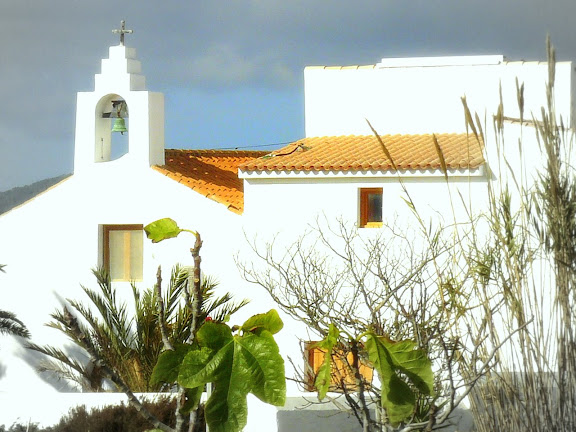
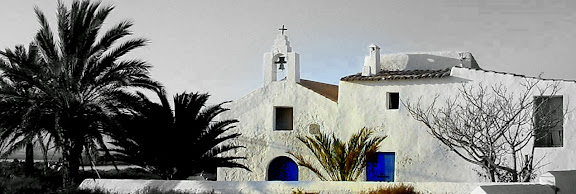
Immaculately white as all churches of Ibiza, this building was not a church but a chapel, but begun as an oratory in the eighteenth century for people working in tough conditions indeed, in the Salinas (salt flats). This chapel is very close to the beach of Es Cavallet and surrounded by nature and a few houses that form a graceful tiny village.
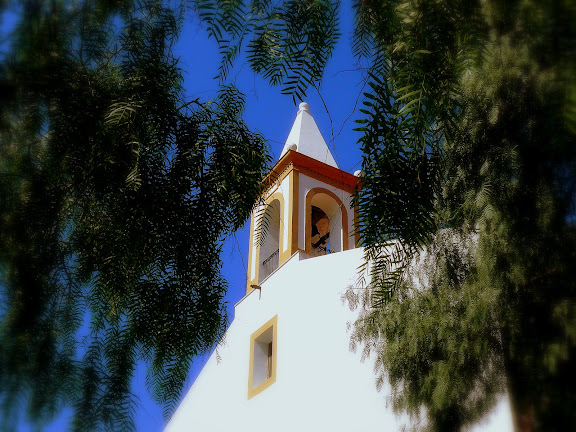
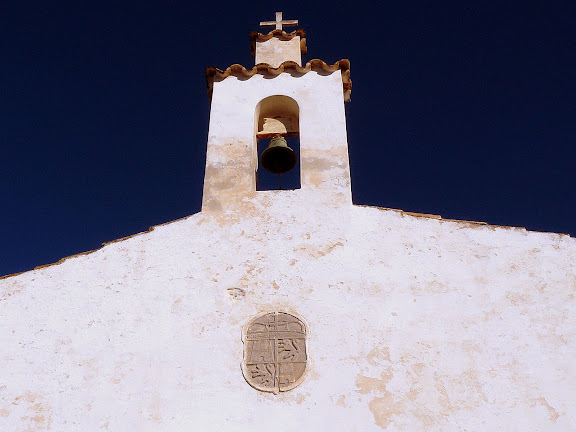
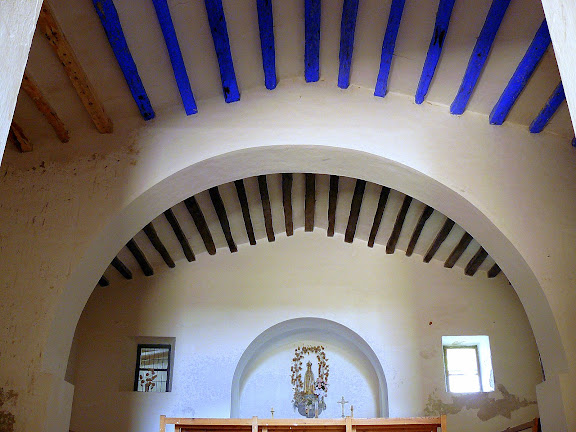
In the altar exists a religious image (even today when no longer is a religious building) of the Virgin of Fatima (do not know why), also ignored the curious fact that on the facade has a shield of Castile and Leon, as well as the nearby tiny church of Sant Francesc. Ibiza in the past belonged to the Kingdom of Aragon, but not to the Kingdom of Castile.

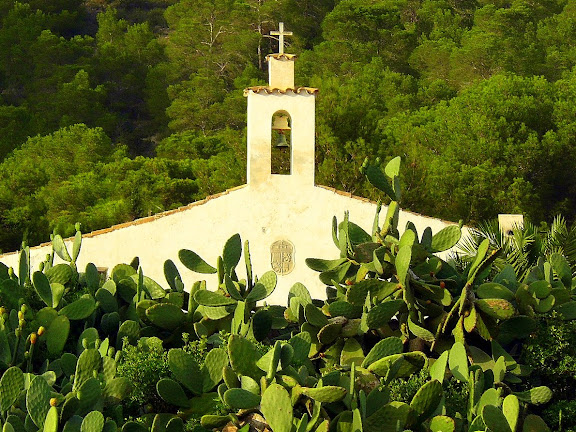
From its doors are easily visible the near salt ponds, with its distinctive flat landscape and square. The pristine white exterior of the chapel often contrasted with the deep blue Mediterranean sky and the gray trunks of the fig or prickly pear greens around the small building.


I take this entry to announce that this blog celebrates during this days the third anniversary since it was born in early October 2008. Thank you very much to all visitors, all who have commented both by mail or directly by the blog and I hope you´ll keep visiting this blog and will continue enjoying it. a big hug to all of you.

May 09, 2011

SAINT GEORGE´S CHURCH - SANT JORDI


PARISH CHURCH OF SAINT GEORGE (SANT JORDI)


Small but strong, not in vain was one of the few that were built thinking about worship and the protection of the population in the past, where Berber incursions were abundant on the island, a dangerous place to frequent looting and kidnapping of people who were sent to other lands as slaves


Small but strong, not in vain was one of the few that were built thinking about worship and the protection of the population in the past, where Berber incursions were abundant on the island and so it was a dangerous place for living due to frequent looting and kidnapping of people who were sent to other lands as slaves.


But along the Christian faith that built this church is the important work of protecting that some churches performed in the past. Here in this church is quite clear, to see the crenellated roof, which made ​​my delight imaginative picturing small battles between good ones(who were inside trying to defend themselves) and bad ones who were trying by all means go inside the small fortress


The roofs of some of its chapels contrasting with the bright white of the walls which in turn are contrasting with the blue sky, all in a very typical architectural vision in old buildings on the island. These chapels are from the eighteenth century when the church was not anymore a fortress and turned exclusively to worship.

Nowadays, as more peaceful time, this building is dedicated solely to the Christian worship. Its simplicity is its greatest feature like most churches on the island. Its three crosses (indispensable in the field churches) are located very close to the front door protected from strong midday sun by a magnificent and large porch that shelters and shade at the entrance of the temple, where voices echo of the assistants to the church service and after they greet and chat themself for a while.


In the western part this building can be seen in a less pleasant side, since instead of the calm white walls from the other side, so here we are aware of the more hard evidence of the previous stone fortress stage.


Below the image of St. George, a saint almost mythological faces a fierce dragon who kills in order to save a beautiful maiden (hence on the island to the inhabitants of Sant Jordi are known by the nickname of "matacucas" kills bugs ) And is venerated especially in former Soviet or Anglo-Saxon countries (eg the flag of England is simply the cross of St. George) that is repeated in countless flags of countries, including Georgia, Sardinia, and the former republic of Genoa among others, and is present in the coats of many places, including London, Milan, Aragon, Catalonia or Barcelona, Freiburg, Batalha in Portugal, Bologna, Montreal ... and even more places. The Moscow coat of arms bears the image of the saint.


April 23, 2011

SAN JOAN DE LABRITJA CHURCH

CHURCH OF SAINT JOHN (Sant Joan de Labritja)


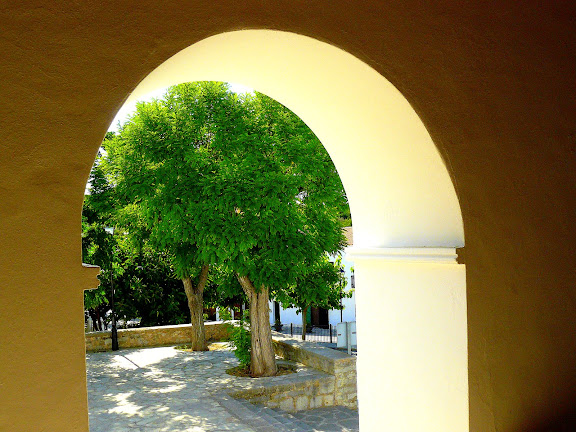
On hot summer afternoon the church square of San Joan is a cool and shaded place by leafy trees shadows. In my particulary case this church is where I have had more family events. Baptisms, communions, weddings and of course some funerals, a church that has marked many of my memories. So come back here (which I usually do not do much) is like coming back home. My mother was born in this town that also is said to be one of the villages where people have the greatest life expectancy in Spain. It is very common to see people who is over one hundred years in this municipality
En las calurosas tardes de verano la plaza de esta iglesia se encuentra fresca y con sombra gracias a los frondosos árboles que cobijan este lugar.


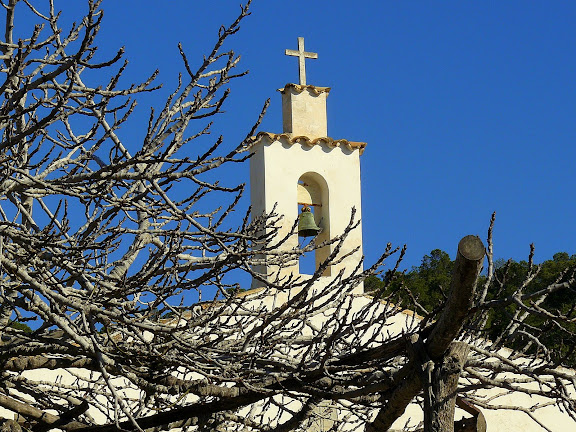
This church is dedicated to Saint John the Baptist and is curious how the bell is said (and totally true), which is equal to the towers that exist on the Asturian churches, and so, although reminds its neighboring town church of Sant Miquel Balançat. Anyway as a whole has an amazing aesthetic typically Ibicencan. whitewashed walls lend an air of white refreshingly its surroundings


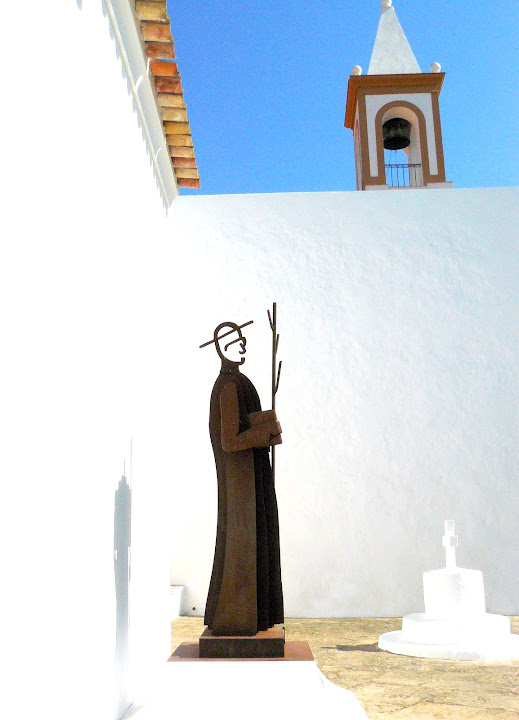
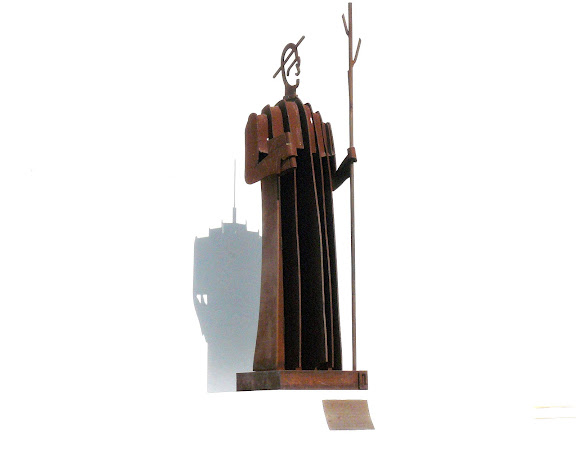
Vicent Ferrer Guash was a beloved priest for 26 years and the nearby parishes of San Lorenzo and San Vicente and was also priest of distant churches as San Rafael and San Telmo this one in the city of Ibiza. Born in 1906 and died in 1,986


In 2,007 some neighboroughs and several institutions have dedicated this monument of modern styling but that is perfectly suited to the architecture and outline of this place. A plaque recalls as a memorial for this beloved priest.


In all churches of the rural Ibiza, there's something not missing. These three crosses together known as Calvary. In this case three large crosses with grand staircases access the form in this church, which like everything that surrounds this place have simple and sober lines.


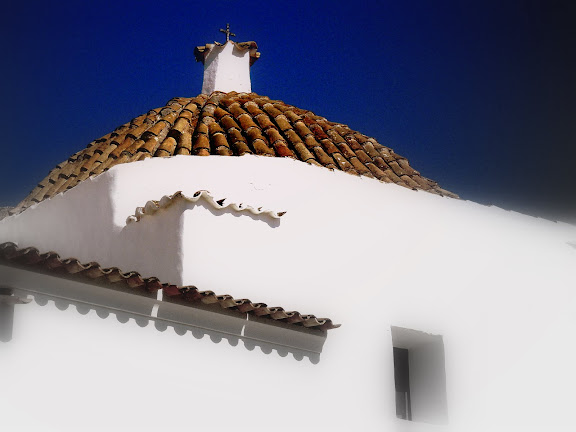
As in most rural churches a small chapel forms outside a kind of little dome, in this case also rural style. Surrounded by white walls are the tiles covering the chapel and when it rains the water droplets leading to a nearby well.


The porch of the church of Sant Joan is placed in one side, like for example the church of Our Lady of Jesus or the nearby San Vicente (Sa Cala)or Sant Antoni de Portmany (although is not usual) from here it can be see the trees in the square and in summer they protect us from the heat and stays cool to the porch.