Showing posts with label MONUMENTS. Show all posts

March 02, 2015

ARCHEOLOGICAL SITE CANA COSTA (FORMENTERA)

MEGALITHIC FUNERARY MONUMENT OF CA NA COSTA IN FORMENTERA
Quite curious the history of Formentera concerning at their population. For much of its history was uninhabited, but interestingly this monument that really would be a megalithic tomb, dated between 1,900 and 1,600. B.C., which shows that at that time Formentera was already inhabited. Aside Formentera would join the islands of Menorca, Sardinia and Malta which have a large number of megalithic monuments as well as Mallorca with smaller numbers of them, while the enigma remains in the absence of such monuments in the nearby Ibiza that could indicate that Formentera on those ancient times, had greater population than Ibiza itself.
It may not be easy to find this monument, but it doesn't really matter for people with no interest in historic stones, but definitely should matter to others with interest into megalithic. But you can find the monument on halfway to the salinas de Formentera and the little town of Es Pujols. By the way we can see in the explanatory poster, that this monument is known by the inhabitants of Formentera as "es rellotge" (means the clock in ibicenco language).
It looks like a dolmen, disposed in  geometric shape. Despite its long history was discovered in the year 1974, where changed the history of Formentera, so, it was ignored then that Formentera was inhabited in the Punic period, and this showed that long before, civilization had existed. It is curious that in later chapters Formentera remained uninhabited several times, for example when Muslims were expelled for the continuing attacks on the island and shrank its population drastically, even dissapeared.
The place is located surrounded of great natural beauty, and you can see the salt ponds and the "estany Pudent" (a great lake of salt waters). Your visit will not last more than twenty minutes, depending on the interest that could awake in each visitor the history of these stones, which incidentally confirms my idea that Formentera and Minorca are very similar, and among its similarity with the landscape can be add that both islands have megalithic monuments.

October 20, 2013

PUNIC NECROPOLIS OF "PUIG DES MOLINS"

NECRÓPOLIS PÚNICA DE PUIG DES MOLINS
The old Ebusus was founded by Carthage in 654 BC and the small hill next to Dalt Vila is perhaps the oldest history test on the island, which is also an interestingly proof that life and death are linked. This mountain was the great necropolis and the hill next to the other was where the life was, but with a fragile border that connects the death and the life, the Phoenicians and Carthaginians lived with both.
It was in the seventh century b.C. when it began to be a cemetery. A spectacular set of hypogea and a series of caves which were accessed through openings in the rock, leading to the place where they were buried Carthaginian contemporaries and was used until Roman times of the island.
These archaeological sites were looted in the past, which made very difficult the study of archaeologists. Although it appears that in Ibiza (unlike Cádiz) the offerings were not of great value, but rather as jewelry, offerings to the dead were simply mud vases and other items made ​​of clay.  
The number of graves in this place is estimated between 3,000 and 5,000 but many are yet to be discovered, of which 340 are visible already. The importance of this place is reflected in the title that gave the UNESCO as a "World Heritage" to Ibiza in 1999, but before, in 1977 it was classified as "cultural interest site".
The influence of the Carthaginians gods was powerful. The ancient island name of Ibosim or Ebusus would come to say that Ibiza was the island of Bes (Egyptian god who came here through the Carthaginians) is often depicted with musical objects, chubby, carefree and even with very big head ... sympathetic buffoon and even something as sexual icon. In contrast, the goddess Tanit was the Lady of Ibiza, and much more complex .... The cult of Tanit had two faces. The friendly one that have to do with the moon, fertility, life and happiness, love goddess and protector of Ibiza, but also with a dark side, as she was also goddess of darkness, hell, health and death and thus was protective of the deads. Perhaps thats was why was so inevitable that death in Ibiza was so present as it is in this place "Puig des molins". And as it´s said, the death is part of life.

February 12, 2011

MILL IN SA PUNTA DES MOLI

MILL IN SA PUNTA
It is believed that the Arabs were who introduced windmills and water wheels and other those days mechanics systemshere on the island. As a child I visited Formentera on a day where I saw that there was something in Ibiza had passed into history, were the mills with blades. Many years after, probably at the initiative of a political culture, became the restoring of few remained standing mills. As a curiosity always amazed me that Ibiza and Formentera´s mills had six blades, two more than those showing in the books from La Mancha (Castille), where Don Quixote attacked those giants. Also those nice ones on pictures surrounded by tulips. The famous Dutch windmills.
The beauty of Ibiza ones had a more primitive, but rough looking. The Ibiza and Formentera mills are similar but not identical to the rest of the Balearic Islands, although in Menorca and Majorca are very similar to each other and have a home below the mill itself.
To talk about these mills in Ibiza, we must refer to the Puig des Molins in Ibiza Town. There are most mills (although only one restored with the blades), there is also one in Puig den Valls, near the city, Puig means mountain and was above the mountains where the wind blew over. But today the mill I propose is the one located in Sa Punta in Sant Antoni de Portmany that unlike the previous ones is located at the coast at the edge of the sea, and when the west wind blows I guess I was rolling and rolling. When was made nothing was around but today is blended into a tourist coast full of hotels and tourist attractions.
They were used to grind wheat and then make a good bread, very important in the island long ago. It seems that some mills in the island date from the thirteenth century and therefore I consider it an asset to be protected ...

March 25, 2010

TOMB OF GUILLEM DE MONTGRÍ IN GIRONA & REPLICA IN IBIZA


Both cities Girona and Ibiza have something in common and is one of the most historic character of the island. Guillem de Montgrí. Born around 1200 in Torroella de Montgrí, arrived on August the 8th 1,235 under the command of James I the Conqueror to Ibiza. Since then Ibiza and Formentera became territories belonging to the Kingdom of Aragon. Into the images on both sides of these lines we see the tomb of this character that is located inside the Cathedral of Girona.
Guillem de Montgrí died in 1273 and the sculpture is his tomb was completed on life of Guillem and created by master Bartomeu of Girona. Guillem de Montgrí was sacristan (sexton) of Girona Cathedral and Archbishop-elect of Tarragona. Guillem de Montgrí had already been involved in the reconquest of the island of Majorca with his brother Bernat

Between these lines two images of Guillem de Montgrí´s statue in the city of Ibiza near the town hall of the City in Dalt Vila, which is a replica of the tomb of the Cathedral in Girona and that the City of Girona gift to Ibiza in 1970.Of the four "cuartons", which divided the island Guillem de Montgrí took both the Ses Salines and the Balançat on the island of Ibiza and La Mola and Carnatge in Formentera. The rest was divided between Pere de Portugal and Nuno Sanç. The land of Guillem would become to the Diocese of Tarragona when he died as he wished.
The reclining statue is situated in what could be called "the balcony of the Mediterranean" in the east side of the city hall of Ibiza. Surrounded by gardens and above the cliffs. After a redesign of this area it is possible to visit again.

November 01, 2009

SANTA AGNE´S CAVE


EARLY CHRISTIAN CHAPEL OF SANTA AGNES

Located at 59 meters on the level of the sea, it is a place where the history and the legend intermingle.
A wide gallery intermingles with others narrow galleries. It seems that the first Christians in the Roman epoch, when the Christian worship was prosecuted, it was here where they meet to practising their cults.
During the 19th century, the Archduke Luís Salvador of Austria already was speaking in his chronicles of Balearics of this place. He was doing allusion to the most ample gallery with a great spring of crystalline waters and where every August 24th the peoples of the island were meeting. It seems to be that a precipice finished with the gallery and the spring, which certainly other historical sources also mention.

It is not known by accuracy when, but also one speaks of that a statue of wood of the Virgin who takes the name of the cave, which from here moved to the church always was returning to appear in the cave. Of here maybe it avenges the tradition of the famous picture (according to a few versions) or famous statue of wood (according to others) of venerated Saint Agnes, that on board of a ship in danger due to a heavy storm, the crew members promised to deliver in the port where they were coming healthy and safe and this it was precisely the Port of Portmany's Sant Antoni on August 24th, and that was this precisely the motive of San Bartolome's current festivity.

October 23, 2009

THE SALT MEN


MONUMENT TO THE SALT MEN

In April 2.007 there was inaugurated this statue of bronze of the sculptor Pedro Hormigo in the same reservoirs of the salt mines of Ibiza recalling and honouring all the workers of Ses Salines that with their hard work were extracting the salt course to the ships or the trains (yes, trains still today can see the rails) where they were loading the salt, with destination on the tables of many families. Never rather that these men were earning their "salary".

The statue measures 1,85 meters high which is what would be a model to natural scale.
The monument is placed rightly next to the church of Ses Saline´s Sant Francesc, and sight of distant view makes us recall these past times where men's big rows with their basket on the head full of salt, were parading these places, today already replaced with machinery that does the same work for fewer "salary".

June 13, 2009

VARA DE REY


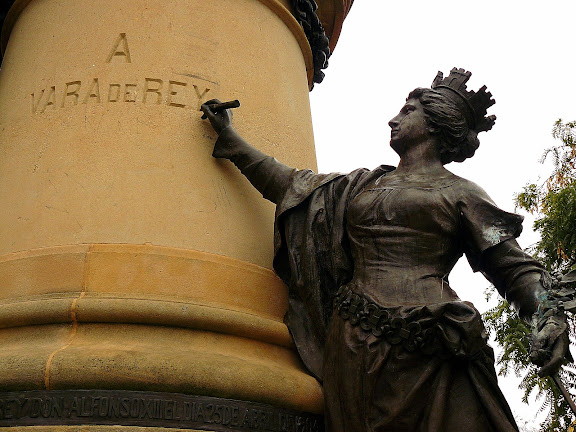
Vara de Rey is the Center of the City of Ibiza. But not many of the inhabitants of Ibiza know who was Vara de Rey. He was a hero of the Cuba´s war.
Joaquín Vara de Rey y Rubió was born in Ibiza en 1.840. He was a military and politician. He died in Santiago de Cuba in 1.898. He enfaced the troops of the General Henry Lawton with 6.899 men against the 550 of the Vara de rey´s troops.

The monument to Vara de Rey was opened by the King Alfonso XIII in april 1.904.
Also exists a monument to Vara de Rey in Madrid.
At Vara de Rey Square in Ibiza you can find the elegant Montesol Hotel which was the very first hotel on the island.


The most important trade and shops of Ibiza are around Vara de Rey Square. It´s placed just around 100 meters from the harbour and very closed to the reinaissances walls.

March 05, 2009

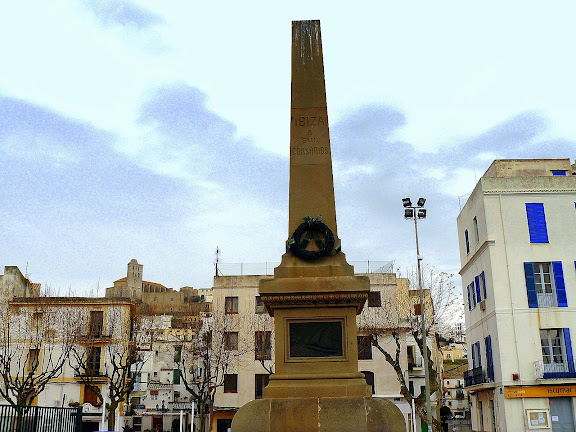
MONUMENT TO THE CORSAIRS

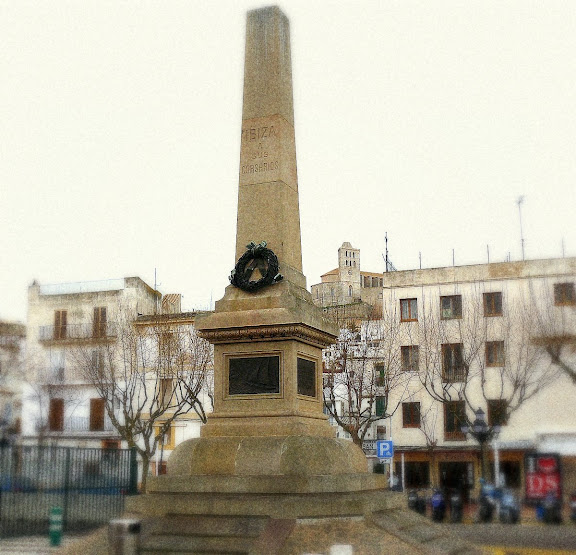
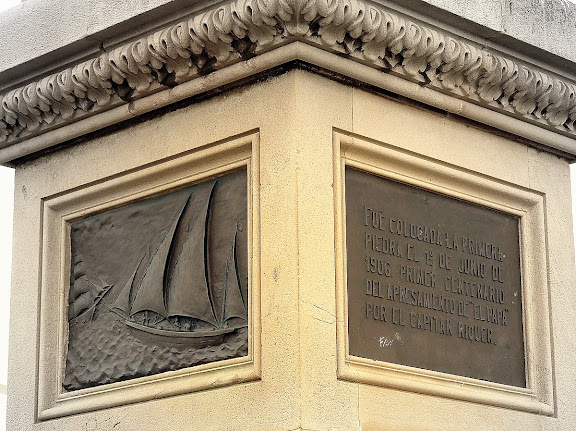
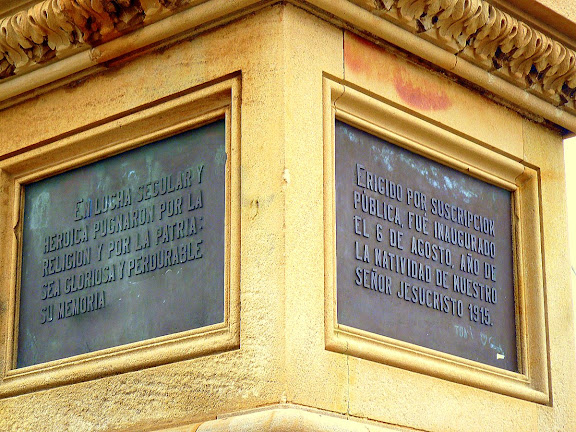
This is the unique monument in the whole world that is dedicated to the corsairs. The corsairs were obviously pirates, but with the "letter of marque" which means that they were legals and authorised by the government. During the XVIII century they defended Ibiza and the inhabitants against undesirable invasions.
This monument is located at the Ibiza harbour and was design by the Architect Augusto Font.
The inauguration was in 1915.