Showing posts with label ARCHITECTURE. Show all posts

August 07, 2016

MILLS IN SA MIRANDA

WIND MILLS  OF SA MIRANDA IN FORMENTERA
Giants memories of the past, when Formentera was hungry and in these mills that transformed the wheat into bread, thus they were essential in the daily life of this small island.
This "venda of Miranda" (venda, means something like neighborhood) is located on the same side of the capital of the smaller island of the "Pitiusas islands", and its main square is easy to find the street called Sa Miranda or Molins de sa Miranda. At that point is where we can find these gigants stone mills (6 are the antlers of wheat mills in Baleares, like those in Malta, which were identical in design to the Balearic Islands). This area although it seems a great plain, is actually the top of a small hill where with certain intensity blew the wind, reason why there are several of them at this very point. As we see in the picture above, today are relatively surrounded by lampposts and telephone, the result of technological breakthroughs that these mills have seen over the time.
In 1,990 these mills were declared of cultural interest, in the nineteenth century were seven throughout the island, only three remain today with the entire structure including the six blades per mill. These two mills have their names as locals know them by their proper names: Moli d'en Jeroni and Moli d'en Mateu. Although I have previously referred to the nineteenth century as a golden age, some of these mills were already in the eighteenth century, but unfortunately from the 50s of XXth century were falling into disuse.
As clearly seen in  one of them, is privately owned and is within the grounds of a private house, but that does not stop us to see its top, while the other one can be fully seen.
These mills are situated at an altitude of 60 meters above sea level, although not seem high altitude, for Formentera which is a very flat island is enough that they might come the winds to blow and make them work, while the people awaited for the results , I mean from his wheat to subsequently get the bread.

June 13, 2016

WORSHIPS AND FORTRESS ON THE PAST

FORTRESS IN THE CHURCH OF SANT ANTONI DE PORTMANY
I have already spoken before that the oldest churches of the island were originally built as temples but mainly as robust and strong fortresses, where people from the village and surrounding areas came not only for attending the holy mass but also was the place they were gathering in case of threat for moorish invasions.
Invasions came by sea, and here at the Portmany port (Portmany was the name of this bay after the conquest of the Kingdom of Aragon, and comes from its former Roman name "Portus Magnus") was an important target of those invasions of the Turkish and Arab pirates, where the invaders were attacking with mercilessly the farms, villages and especially to their inhabitants that made them their slaves. That´s why were so crucial that the church as main building had to be well defended, so that´s why its square and strong tower (the only square shaped defence tower of the island) had to hold powerful guns, as cannons that protected the population, from the barbarians incursions. 
Undoubtedly this tower located at one side of the church building is looks as that of any other castle. And this was where the population was feeling much safer on attacks. This tower dates from the sixteenth century and from there by sounding a sea conch shell, warned the population of the imminent danger of the incursions that was about to stalk people, making to everyone was running to take refuge here.
The guns had a range of about 4 kilometers, far enough to protect the harbor and able to sink any invader ship. Still at this temple we can see a moat between the bell tower down to the front door of the temple, where the population received the invaders by pouring through it, large amounts of boiling oil when they were trying to go into the temple. and of course helping this way to repel the attempted entry. Anyway the doors were made of iron, in order to prevent be burned and thus destroyed. Today the guns have not anymore the wide visibility that they had then, now great buildings surround this temple, as this town now is an important tourist resort and makes the church to be a real miniature.
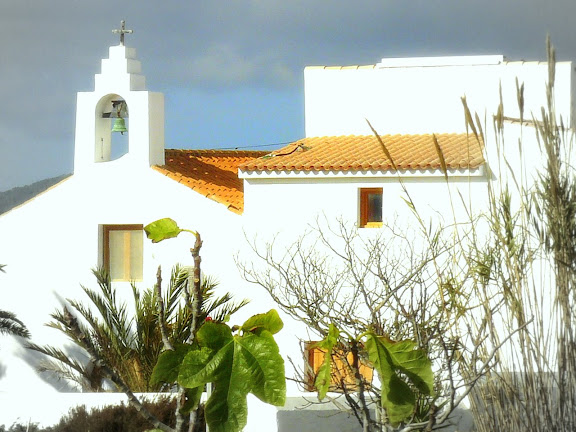
Slowly, as the threat of invasions were diminishing, the temple left his defensive character to become gradually in religious and worship temple.
And then after the main steeples were built, in Sant Antoni Abad the bell tower has two bells named after Angela and Mary, the first because it was used to play the Angelus hours, meanwhile the other used to call the Mary prayer during late in the afternoon.
 For this reason in the ancient worship temples of Ibiza most of them that exercised that function do not have windows and if thick white walls (except for the tower is made of stone and was never painted white).

August 20, 2014

THE NEW WALK AREA IN SANTA EULALIA


NEW "PASEO" IN SANTA EULALIA

The village of Santa Eulalia inaugurated some weeks ago, the new town hall square next to the promenade of the sea, now seems much broader, taking advantage of the space and the great sea views; now it is possible to see the sea from the town hall due the architectonic change of its square. This place is now enjoyed it by its inhabitants and visitors. Santa Eulalia remains being the second largest population of the island, a place where the essence of the island is present. 
 
For this remodel, I'm sure it takes into account the relationship of this town (also known as Villa river) with the water and its river. The water was an abundant good in this area of ​​the island, so, here ends the only river of the spanish islands. Today dry unfortunately (except when it rains).

The traditional irrigation of arab origin, performed and as present in the rural countryside of this island, is represented here by these staggered channels that lead from the city hall to the sea, along the area.

These channels lead us to the sea from the Town Hall, and meanwhile we can begin to enjoy magnificent sea views as we approach the promenade of Santa Eulalia that merges with this new ride at one of its ends.
  
Another of his innovations are the new sources that although there were some sources before, just opposite the Town Hall, now they are much more impressive and have changing lights and can even dance onto the beat of music. Again thanks to the new design of these sources, this square has much more space now..

A classic of Santa Eulalia town is this ancient cistern that have been preserved with the remodeling of this ride and has been not touched, though now without the heavy traffic passing right in front has become a wider pedestrian zone..

They have incorporated some bronze sculptures of something as representative for the island such as the Ibizan hound breed that surely comes from Egypt and was brought to the island by the Phoenicians who had contact with the people of Egypt and they were the first inhabitants of the island . These dogs have become an attraction over this area and are one of the most photographed devices as well as the pixies that are playing near water (their habitat) they also are characters that are closely related to this Villa. The hounds and the elves can also enjoy the sea and the many tourists who walk through the area....
I believe that Santa Eulalia del Rio has become a prime tourist population in Ibiza, which has nothing to do with some bad reputation that sometimes has the island and is that who will visit this town, they will see how people enjoy without need of drinking alcohol all time or drugs, on the contrary, these are people of all ages who enjoy the shops, restaurants and all that this beautiful and unavoidable villa offers..

February 14, 2014

CHURCH OF SANT FERRAN DE SES ROQUES

CHURCH OF SAN FERNANDO
ES PUJOLS
In the main tourist resort on the island of Formentera (Es Pujols) this church that has the particularity that it is built of stone outwardly, not follow the architectural canons of being whitewashed in white, like most churches of Ibiza and Formentera due it was built with sandstone. During the Civil War as most religious buildings was severely attacked. It is the smallest of the temples of Formentera. 1.996 In was declared a Cultural Interest site.

But indoors the small temple remains in white, as these architectural rules of the Ibiza and Formentera churches are distinguished, inside the characteristic white both inside and outside the parish. On the main altar, the Image of this Saint of Seville, whom this temple is dedicated.
This parish was created in 1785 with the creation of parishes, and due to a decree regulating the creation of a third parish in Formentera, on the salt ponds (although not to be built in that area, due the weakness of the land and building was later  this church in its present location) was begun in the year 1853 although the cult began in 1889, although since 1785 the neighbors could hear the mass in a chapel dedicated to Saint John.

February 07, 2013

A WALK IN THE COUNTRYSIDE OF IBIZA

A WALK IN CORONA
Winter is one of the most beautiful season to enjoy the countryside of the island. It´s True that sometimes the weather is not really nice but in few days the weather changes for good and no rain or wind, and in numerous occasions we have an anticyclone above that gives us sunny days like these last days and where walking through the countryside is a delight. One of the most amazing things are these isolated houses of the island countryside. Although local architectural canons bet on the white following a Phoenician tradition of whitewashing the house, some are stone. The green countryside contrasts with these houses with stone colour.
The traditional Ibiza´s house starts with a relatively small building of one room and as the children born, or depending on whether the new marriage had to stay living with the parents or parents in law, the house become bigger and usually adding new rooms when needed with the growth of the family. Some had two floors.
Although most houses like the image above itself is whitewashed, some of the side walls were left unlimed. Sometimes the traveler will be able to watch when unlimed walls, that the doors and windows have a white frame around them, or even some with a white cross, which was used to ward off witches and evil spirits, due to when a few decades ago Ibiza was still an island with many superstitions.
This one on the image could be an example of a house starting to be a home for a newlywed couple who lived alone, and still without any children. Just with an inner porch that served as a living room, a kitchen and a room.
Further, they were adding more units at the house; rooms, corrals, barns and whatever was needed. Sometimes the whitewashed area of the house, tells over the oldness of the building respect to the not whitewashed area, that was generally the newest. .
Special features of typical houses were that they were usually surrounded by trees, olive trees, carob trees, prickly pears, or even (as something exotic but very common) a date palm. Another essential element formerly were the cars, a mule or horse(depending on the capabilities of the family) always was in a separate place from the main house. The car carrying the seed from the fields to the barn to the house during the work week, and on Sunday the carriage was used for the family for transportation to go to town (usually at some distance) to hear Mass and meet the village people. It was the rural Ibiza, on a very different times...

December 17, 2012

CHURCH OF SAN FRANCISCO IN FORMENTERA

CHURCH OF SAN FRANCISCO JAVIER IN FORMENTERA
On December 3 Formentera celebrates the feast of Saint Francis Xavier (San Francisco Javier) and the main church of Formentera is dedicated to him. Simple as the island itself, this church stands in the middle of the largest population of the small island. White walls inside this temple and architectural features as churches of the pitiusas, and very big looking outside, reminding us that, even built as a temple when the anxieties of Berber incursions were about to end, it could still have been used as a fortress against these dangerous attacks in case of need to do so.
By then, on the island there was only one place of worship, was the small chapel of Sa Tanca Vella, and early on the eighteenth century it was decided by the Archbishop of Tarragona, from which depended the churches of Ibiza and Formentera, build a large church and that was performed on the year 1726, with the collaboration of all the inhabitants of the island. The main altar we see today (pictured above) was added after the Civil War since the original was burned during the war.
The Church today is located in the middle of the main square of the town of Sant Francesc, and in front of the small council. A beautiful square which is the main meeting place for tourists and locals. A small and limed well it gives local charm, and next to it, we can see the ancient and massive defensive walls of the church.
And of course, we also see the calvary (set of three crosses that are usually at the entrance of churches of Ibiza and Formentera) at the outside white wall. Formerly the exterior walls of the church were not painted, so it had a hard aspect of a large grey building, currently whitewashed in its main facade. All this turns in a much more Mediterranean look, and it gives a especial atmosphere to all the square.

September 23, 2012

CHURCH OF SANT FRANCESC

CHURCH OF SAN FRANCISCO DE PAULA
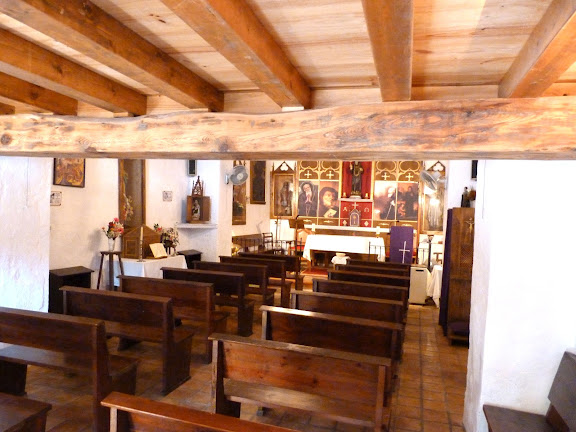
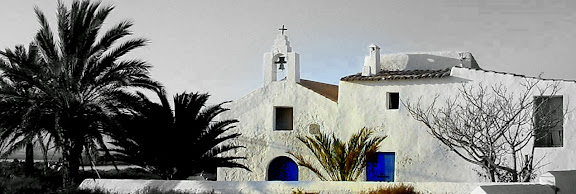
Located within the "salinas" of Ibiza, this small parish is dedicated to St. Francis of Paula, and known as Church of Sant Francesc de s'Estany or Ses Salines. Its charm lies, not only in being in one of the most spectacular places on the island, but the simplicity of the small temple. The new altar was inaugurated this year, thanks to the efforts and enthusiasm of his pastor priest, that he performed it from old photographs that exist of the former ancient altarpiece. This new altar piece added some allegorical paintings on the life of St. Francis of Paula who is dedicated this parish church.
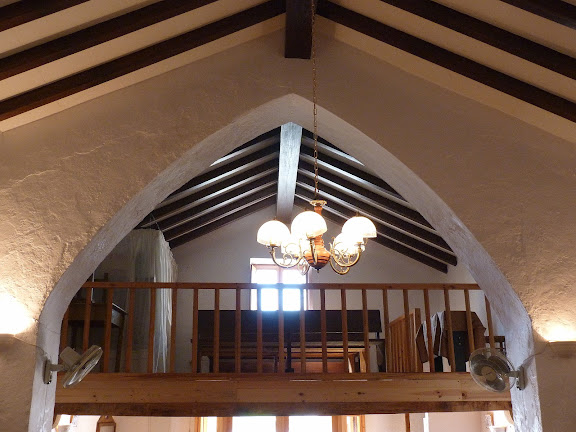
As architectural complay the fees of the Ibiza churches, should be white and simple but also it has the "honor" of being the smallest church on the island. Everything in here is small. Even paradoxically has his choir on the top floor, which are not all the churches of the island even being much bigger that have it.
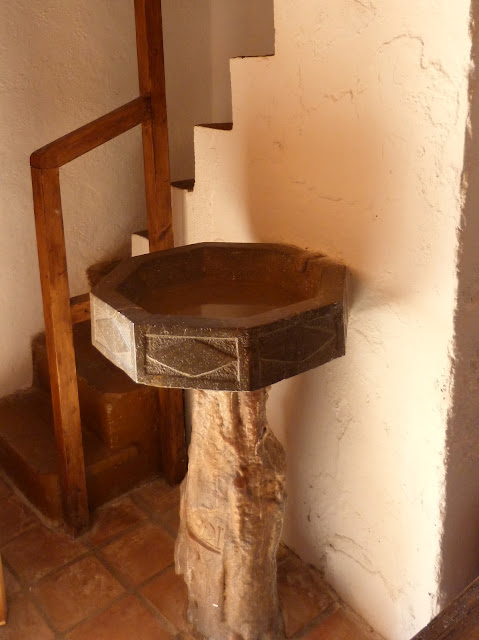
Sometimes some details are small surprises, such as the font of holy water (pictured above) which is located right next to the narrow staircase that leads to the choir. when we look at the ceiling we will see the amount of wood beams on the rustic way of typical houses (at the countryside) of the island. This church was built in the early eighteenth century. Although it is believed that was built on a previously existing chapel on the fifteenth century to meet the religious needs of the salt men who work at the near salt mines, then became a church in the year 1785.
The people of this area are very proud of their small but beautiful church, most of the religious images have been donated by some of them, and inside there are enough images that have nothing to envy in size and in numbers to the other larger churches . One of the surprising things in this temple is a shield of Castile in its facade, the reason for that, is that after the Civil War the salt mines passed to belong to the crown rights due the conquest, and the crown was responsible for the religious purposes of this place, where lived of salt workers and residents of the neighboring orchards.

July 03, 2012

THE HOUSE OF LAVENDER PLANTS

 
WHITE AND LAVANDER COLORS
 
Walking through the countryside of Ibiza we may find amazing surprises for those who love lavender (allow me, to dedicate this post to a wonderful girl who loves these plants). This shrub grows wild only in the western Mediterranean and is a symbol for an area of ​​France (The Provence), where fields are covered all over with its lavender flowers of this lilac characteristic color of this plantation. Besides culinary uses also has its place in pharmacies devices, and also as medicinal plant as well as decorative.
 
But surprisingly also in Ibiza this plant is present in forests, and in many gardens or decorating in some roundabouts and public gardens. Also in this house is tastefully completely surrounded by lavender, and everywhere seem to have adapted well to the dry land, to the strong summer sun and to the damp winter of the island. Besides the lavender, the white walls of the rural house made a nice contrasting.
 
this house is in the rural north of the island. Its small size makes it a simple house and even increases their beauty. this house is located between forests, and with its white walls, green forests and lavender flowers make this place a beautiful and unique in Ibiza.
 
With its simple houses and buildings, the evergreen fields, make this island a unique island in winter and summer, perhaps in summer many people forget that the rural Ibiza interior also exists, to the detriment of the beaches and coasts which are full of people, that makes that we opted for the inside Ibiza for enjoy more the solitude of these beautiful spots.