Showing posts with label WORLD HERITAGE. Show all posts

October 20, 2013

PUNIC NECROPOLIS OF "PUIG DES MOLINS"

NECRÓPOLIS PÚNICA DE PUIG DES MOLINS
The old Ebusus was founded by Carthage in 654 BC and the small hill next to Dalt Vila is perhaps the oldest history test on the island, which is also an interestingly proof that life and death are linked. This mountain was the great necropolis and the hill next to the other was where the life was, but with a fragile border that connects the death and the life, the Phoenicians and Carthaginians lived with both.
It was in the seventh century b.C. when it began to be a cemetery. A spectacular set of hypogea and a series of caves which were accessed through openings in the rock, leading to the place where they were buried Carthaginian contemporaries and was used until Roman times of the island.
These archaeological sites were looted in the past, which made very difficult the study of archaeologists. Although it appears that in Ibiza (unlike Cádiz) the offerings were not of great value, but rather as jewelry, offerings to the dead were simply mud vases and other items made ​​of clay.  
The number of graves in this place is estimated between 3,000 and 5,000 but many are yet to be discovered, of which 340 are visible already. The importance of this place is reflected in the title that gave the UNESCO as a "World Heritage" to Ibiza in 1999, but before, in 1977 it was classified as "cultural interest site".
The influence of the Carthaginians gods was powerful. The ancient island name of Ibosim or Ebusus would come to say that Ibiza was the island of Bes (Egyptian god who came here through the Carthaginians) is often depicted with musical objects, chubby, carefree and even with very big head ... sympathetic buffoon and even something as sexual icon. In contrast, the goddess Tanit was the Lady of Ibiza, and much more complex .... The cult of Tanit had two faces. The friendly one that have to do with the moon, fertility, life and happiness, love goddess and protector of Ibiza, but also with a dark side, as she was also goddess of darkness, hell, health and death and thus was protective of the deads. Perhaps thats was why was so inevitable that death in Ibiza was so present as it is in this place "Puig des molins". And as it´s said, the death is part of life.

July 27, 2013

TANIT THE CARTHAGINIAN GODDESS

TANIT GODDESS
GODDESS OF IBIZA
From the V century a.c. when the Carthaginians brought the cult of the goddess tanit to Ibiza, this image has become a symbol and icon of the island. Unfortunately during many years has been kept in a museum and bolted closed and now finally after many years has reopened the doors, so it can visited it again, in the Archaeological Museum des Puig des Molins in Ibiza Town . Ibiza is not the only place that worshiped this goddess but also in a wide area Mediterranean and North Africa, especially in Tunisia (from the then powerful Carthage came the Carthaginians to Ibiza), Lebanon, Sardinia, Sicily (which is where it´s believe this image came from) or even in the current Spanish east coast. Tanit was the goddess of love, fertility, death, prosperity, harvest and the moon, and she was the most important divinity for the Carthaginians. Also paid him bloody offerings as firstborn children when things were not going well, in rituals held in the cave is Cuieram (north of the island, where were found numerous representations of this goddess) when the ancient people believed that their goddess was angry. The cult became obsolete with time, but recovered when the hippies came to the island on the 50´s and 60´s. In fact this image has become an icon of the island.

March 06, 2013

BACKSIDE OF DALT VILA

BACKSIDE OF DALT VILA  (ES SOTO)
Dalt Vila is one of the most interesting and beautiful sites of the island and the most important. Heritage Site since 1999, is one of the most photographed places in the Balearics. Currently under restoration, the Ibiza Castle, we will gradually discover the results of a restoration, that although is not finished yet, have no liked in general at most of locals, due the wall colors. The historic building which is the former castle will be the future Parador Tourism. Anyway stroll through the area around the walls (the Renaissance walls) is a delight, especially when these great historic walls, can cover the new garish colours of the castle.
Another reason to visit this area are the views of the port of Ibiza, they were years ago a real visual treat to see the island with the Botafoch lighthouse. Nowadays the views are also nice but also can be seen the progress surrounded by concrete at the new harbor. Gradually the island gets to know the wild side of progress. In any case, the views are still quite nice and the close sea with its blue-green color gives the color note to the landscape. On one side of the stone walls on the other sea port Vila (Vila, is how the locals call to the city of Ibiza).
Reforming what (I suppose, if no other changes) will be the future parador (in a place where there is no lack precisely of tourist beds) is appearing before our eyes. A reform that may have raised controversy when was builded a floor over, and the height of the old castle, surpass the cathedral tower. Another of the "innovations" that have not liked by many "Ibicencos". In any case it is still a special place that should not be missed when visiting the island. This area seems to be that from now delight us with their varied new colors.

September 06, 2011

REFLECTIONS ON THE SALTWORKS


SALTWORKS REFLECTIONS

The Saltworks of Ibiza were the first industry on the island and it seems that the Phoenicians began to exploit themselves there around in 600 BC, later other cultures that inhabited the island temporarily continued with the production. The salary as such we know today were once paid in salt, and that was well knew by Romans who also settled the island and exploded the saltworks as well.

Their square shapes make their ponds retained water usually flat and that the landscape as well as the walls that divide the pond are reflexed, which is that being as they are a very interesting natural landscape also have their more abstract image.

During the sunsets, all is fully reflected, not only the landscape but also the multi-colored sky as the time pass, it changes making this place a very pleasant area. I have to mention too the declaration of Ibiza that the World Heritage Site by UNESCO includes both saline are in Ibiza and Formentera

August 16, 2010

PLAÇA DE VILA


VILA´S SQUARE AT LATE AFTERNOON


Located within the walls, once passed the Portal de ses Taules and the main square, we get to what was the undisputed center point in the walled city now known as Dalt Vila and in 1999 was declared by UNESCO "World Heritage Site".

Sunset is a good time to get to the Plaza de Vila, where the hues of the walls take on a strange ocher color and contrasts of sun and shade are obvious.
In this gate called Portal de ses taules starts the "Dalt Vila" area and from here one can take several alleys that lead us to different areas of the upper area of Ibiza old town.

When sunlight goes down, the restaurants in this historic area, are decorated and in a few hours you will be able to dining by candlelight. With calm, the place will fill up with people from so many different countries as culinary offers exists in this area.

Despite the many restaurants in this area should be better to book a table in some of them, since there is large demand. Besides the restaurants are also plenty of trendy shops, art galleries and antiques. A place with character that could be defined as the "center" of Dalt Vila.

May 11, 2010

MEDIEVAL IBIZA


IBIZA - WORLD HERITAGE

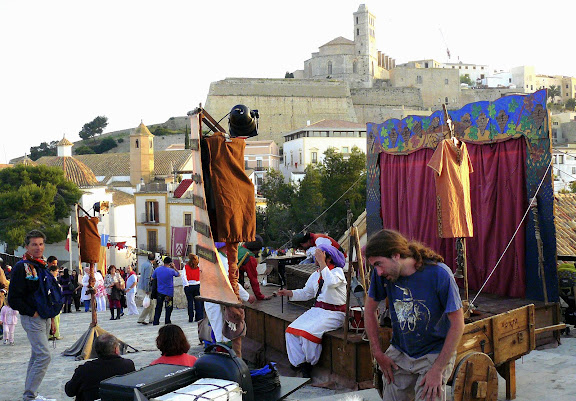
During three days Ibiza City returns to its medieval past and prepares special decoration streets and an awesome medieval market all over.

UNESCO in 1999 declared "World Heritage" the Old Town of Ibiza (Dalt Vila), and because it was decided since then to a medieval festival in this frame every second weekend in May, creating the Medieval Market.

Three days of intense activity in this city and where both locals and visitors can enjoy so many activities. One way to return to the past times ...

Troubadours, musicians, mystics, soldiers, Carthaginians, peasants, witches .... for everyone there is a place in this megafestival.

Also there are a big offer of classical concerts in which mainly dominates the Baroque classical pieces. This concerts are performed with the silent enviroment of the Church in Santo Domingo´s church (former dominican convent) or at the cathedral.

Adlib fashion boutiques, share these three days with other clothes and fashion, such as dresses and suits a little "retro" and even habits of the Templars.

Falconry also have their place here, where you can see the flights of domesticated falcons, eagles, owls, or some foreing variation from out the island as this vulture which shares its curiosity with the many visitors who camped around him.

We can observe from ancient writing methods, useful at the time, tools, etc...

The spinning wheels of the ancient tales are also present in the streets of the city. With an ideal presentation with the latest medieval fashion.

Soldiers, guards, minstrels, jesters, knights, Templars, monks .... all visitors are walking through them ...

The mythological Fates these days become reality in this city. They weave the thread of life, the products that visitors can purchase.

Crafts, and products that can not usually find in the stores can be buyed in here, and for that many visitors are taking advantage of these three days to buy things they can only do so at this time.

The city and the walls are decorated to receive the flood of visitors who can barely move in some of these narrow streets of Dalt Vila.

The medieval girls smile at visitors to the third millennium and share their everyday medieval to contemporary XXI.

Women who strive and work as they were at that time. Some of these works a few decades ago is still performed with some frequency in the island.

Or men with their hands make big baskets or anything that can make with "esparto" or similar ......

Peasants gather to work and sell what they do during those days in this strange market.

Delicious meat also in avalaible in this great medieval market. Made on the grill and where the smell of meat is distributed through the streets, stimulating the appetite of the tired visitors.
Three days that are already part of many visitors dates in their diaries.
The second weekend of May.

August 04, 2009

FESTES DE LA TERRA - CATEDRAL DE IBIZA


IBIZA´S CATHEDRAL

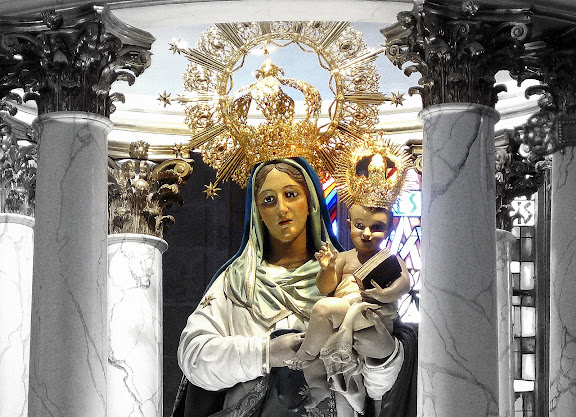
The Cathedral of Ibiza is under the advocation of Our Lady of Snows (which is difficult to understad due the few times that snows in the Island) but we can find an explanation with the history. the August 8th of 1235 the troops of Guillem de Montgrí, arrived to Ibiza with an expedition of behalf Jaime I the Conqueror. With them they brought a new religion to this Island, the Cristianity. They want to have the Virgin as the Patroness of Ibiza, but they had to find the nearest advocation by the calendar so that was the 5th of august with Our Lady of Snows.

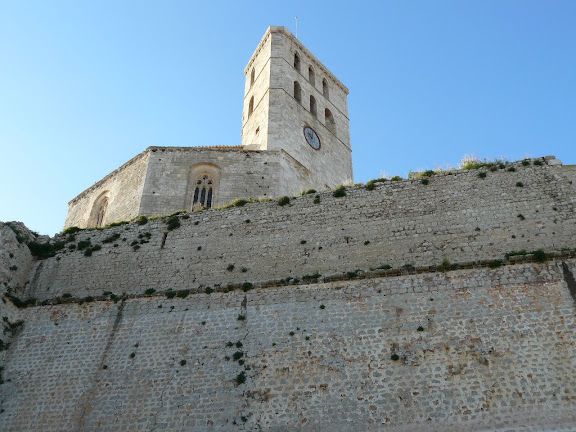
The Cathedral is located at the very top of the dalt vila´s hill. From there we can enjoy a awesome view of the city and a part of the Island.

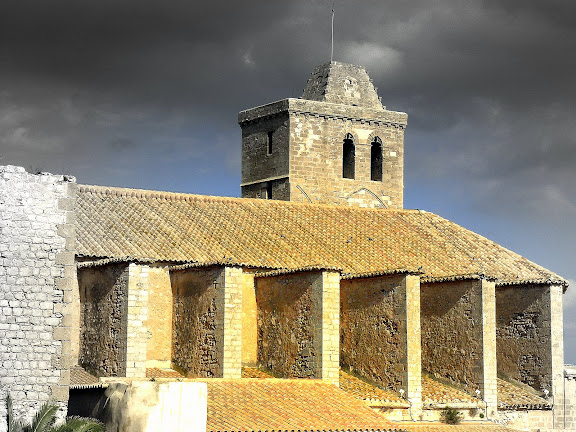
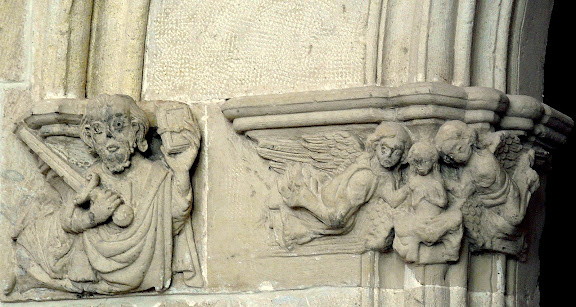
At the beggining the Cathedral was built in gothic style, but after many reforms the style is a bit difficult to say. Anyway and still today we can see some details of the old gothic as the one in the picture below.
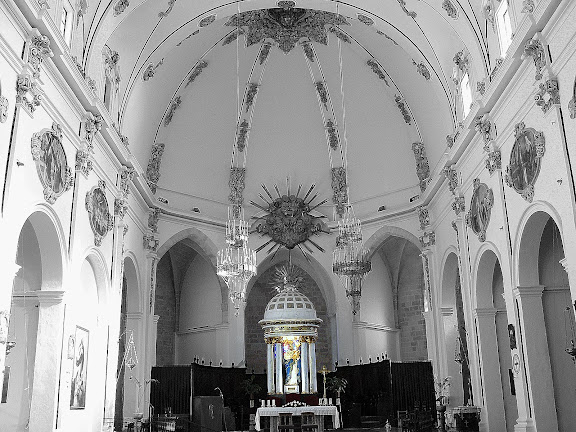
Inside the temple we can see white walls as near all churches in Ibiza.
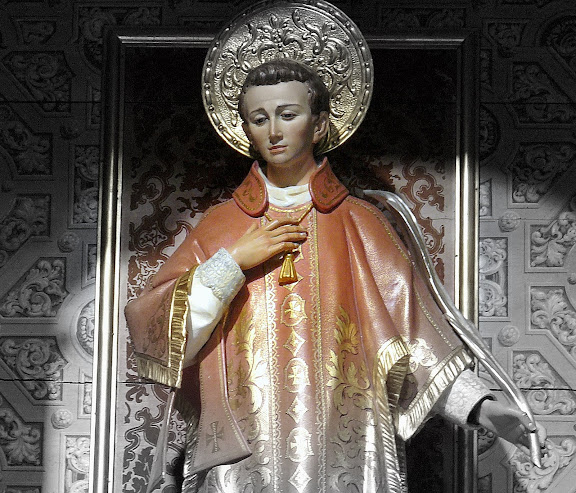
In the picture below we can see an image of Saint Ciriaco, which it doen´t exist to much devotion. He is in fact the Saint Patron of Ibiza. The festivity of this Saint coincides with the big fiesta day of the "Festes de la terra" which is the 8th of August. This is really the historical day of the Reconquest of the Island by the Aragon kingdom. Every August 8th a Te Deum is celebrating in to the Cathedral.