February 25, 2014

SA COVA DES VI

SES FONTANELLES
 The Cova des ví (wine cave) makes reference, to that was used to store wine mainly due to the qualities of the cave to preserve the wine. This occurred in the early twentieth century and also vinyards were planted in the nearby meadows.
Located on the cliffs of Cap Nonó also called Nunó, this cave is within in the Ses Fontanelles area, and the only cave paintings found in Ibiza are into this cave. Anyway the paintings not clarify the motives and the meanings and so, the researchers do not agree even on dates of these ancient drawings.

The cave is located about 40 meters high on a cliff with access from inland, and there is another access from the sea. the inland way, it is relatively close to the beach of Cala Salada and the nearby cliffs create beautiful landscapes.
The cave paintings are schematic drawings, and do not yet known its interpretation or meaning. They appear very similars to the drawings in a cave in Sicily, although these of Sicily is known they belong to the Punic period. These paintings were discovered by a French abbot in 1917, and he thought, that were a drawing of boats and they were prehistoric, and he pointed that dates back to around the year 1000 BC. Although I must insist that the experts fail to reach an agreement on the chronological significance of the paintings, which could be of the same period of the drawings of the Punic period of the cave in Sicily.
In any case, there is no doubt that although not worth maybe get there for the paintings themselves, it is for its scenery surrounding the cave, which has as a background the nearby sea, in contrast to the rocks or the bushes..
If we watch up, above us, this vertical wall of impressive cliffs, we may think it will fall over us. Really impressive....
And although this cave is surrounded by greenery by on one side, the other we can see the impressive and immense stone wall, that get lost into the heights.
If we wish to extend our route, we can go down to the sea by a stone staircase, and there, very close to the sea level, we will find the cave de Ses Fontanelles (sometimes is confused with the name given to the before mentioned cave), the Cave de Ses Fontanelles has a natural water birth.
Once upstairs again, from were we started to go down to the cave, we can take another path surrounding the "Puig Nono" that will take us to the village of Santa Agnes de Corona, and as we travel, on the way and close to the road, we can admire ancient lime kilns or abandoned farm houses.

February 14, 2014

CHURCH OF SANT FERRAN DE SES ROQUES

CHURCH OF SAN FERNANDO
ES PUJOLS
In the main tourist resort on the island of Formentera (Es Pujols) this church that has the particularity that it is built of stone outwardly, not follow the architectural canons of being whitewashed in white, like most churches of Ibiza and Formentera due it was built with sandstone. During the Civil War as most religious buildings was severely attacked. It is the smallest of the temples of Formentera. 1.996 In was declared a Cultural Interest site.
But indoors the small temple remains in white, as these architectural rules of the Ibiza and Formentera churches are distinguished, inside the characteristic white both inside and outside the parish. On the main altar, the Image of this Saint of Seville, whom this temple is dedicated.
This parish was created in 1785 with the creation of parishes, and due to a decree regulating the creation of a third parish in Formentera, on the salt ponds (although not to be built in that area, due the weakness of the land and building was later  this church in its present location) was begun in the year 1853 although the cult began in 1889, although since 1785 the neighbors could hear the mass in a chapel dedicated to Saint John.

December 24, 2013

SEASONS GREETINGS

Once more I would like to wish you all the best for this Christmas, and this time through this picture that you can see at the first floor of Saint Rafael church at the center of Ibiza, (esglesia de Sant Rafel), where is held once a month an anglican church service. This picture is featuring the Nativity on Ibiza, (left side, salinas with the flamingos and at right a windmill, the cave is a ibicencan house, and pine trees, the shepherds are ibicencos with the typical costumes.

MERRY CHRISTMAS 
...and see you next year.

October 31, 2013

SALT PONDS FROM THE AIR

LAS SALINAS FROM THE AIR
The Ibiza salt ponds are the main part of the Natural Park of Ses Salines of Ibiza. Extended over an area of ​​approximately 2,800 acres. Seeing the salt ponds from the ground level, has nothing to do with those, who are lucky to see them from the air, because at this point we deployed a colorful visual landscape, reminiscent of a color palette of a painter. This place is chosen by a large majority of birds during their migrations. Some ponds may be visited regularly by many flamingos that spend time here before moving to Africa.
The ponds vary in color from one to other, through tone colors pink, yellow, green, blue and ocher. The ponds are surrounded by green vegetation mountains and the sea. The result of the evaporation of water from these ponds is obviously the salt that appears in some ponds, the salt will be collected and transported by boat to the Iberian Peninsula or to some other european destinations..
it can happen that some cloud greets us before landing at the nearby airport, today we were lucky and we have gone over this impressive and colorfully place and this is not usual to take this air route. In the image below we see a piece of beach, specifically the "es cavallet beach". Also see the top of the same photograph, where is easy to see the Ibiza airport very close to the salt ponds.
There were the Carthaginians who began to exploit these salt ponds which also still in use today, is therefore the oldest company on the island. Had much impact and importance during the Roman period of the island. Today it is one of the most spectacular scenery on the island, but at ground level the beauty is different from the one we enjoyed from the sky.

October 20, 2013

PUNIC NECROPOLIS OF "PUIG DES MOLINS"

NECRÓPOLIS PÚNICA DE PUIG DES MOLINS
The old Ebusus was founded by Carthage in 654 BC and the small hill next to Dalt Vila is perhaps the oldest history test on the island, which is also an interestingly proof that life and death are linked. This mountain was the great necropolis and the hill next to the other was where the life was, but with a fragile border that connects the death and the life, the Phoenicians and Carthaginians lived with both.
It was in the seventh century b.C. when it began to be a cemetery. A spectacular set of hypogea and a series of caves which were accessed through openings in the rock, leading to the place where they were buried Carthaginian contemporaries and was used until Roman times of the island.
These archaeological sites were looted in the past, which made very difficult the study of archaeologists. Although it appears that in Ibiza (unlike Cádiz) the offerings were not of great value, but rather as jewelry, offerings to the dead were simply mud vases and other items made ​​of clay.  
The number of graves in this place is estimated between 3,000 and 5,000 but many are yet to be discovered, of which 340 are visible already. The importance of this place is reflected in the title that gave the UNESCO as a "World Heritage" to Ibiza in 1999, but before, in 1977 it was classified as "cultural interest site".
The influence of the Carthaginians gods was powerful. The ancient island name of Ibosim or Ebusus would come to say that Ibiza was the island of Bes (Egyptian god who came here through the Carthaginians) is often depicted with musical objects, chubby, carefree and even with very big head ... sympathetic buffoon and even something as sexual icon. In contrast, the goddess Tanit was the Lady of Ibiza, and much more complex .... The cult of Tanit had two faces. The friendly one that have to do with the moon, fertility, life and happiness, love goddess and protector of Ibiza, but also with a dark side, as she was also goddess of darkness, hell, health and death and thus was protective of the deads. Perhaps thats was why was so inevitable that death in Ibiza was so present as it is in this place "Puig des molins". And as it´s said, the death is part of life.

October 02, 2013

THE ROMAN ROAD IN FORMENTERA

"SA PUJADA" DE FORMENTERA
Among the islanders is known as "Sa Pujada" the Roman road that in remote times was the only access to the top of the Mola in Formentera. A natural espace in the woods by a historic road on the island of Formentera and with views that will amaze us.
The road does not have too much difficulty, actually is a slope through thick forest during a while and after when it becomes no so thick, lets us see a breathtaking view of the island. It is ideal for an overcast day where we can not enjoy the beach (eg.).
During this way we will see the cliffs on different heights, due the road is always passing near the coast, and in some scraps the way is on a quite considerable height. We're going down to the tourist area of ​​Es Calo. This road in antiquity was much larger than the scrap that remains today of this ancient road.
In December 1993 this road was declared " Bien de interés cultural" (merit of cultural interest) on category of monument.
During our walk we can see amazing things as an old well which dates from 1889. The wells are a constant in this island, where the rain water is a treasure. As a curiosity it is noteworthy that as decor has a plate with the name of Formentera but the picture belongs to a woman with the tipical attire of "Mallorca".
Once at Es Calo if the weather is with us we can take a dip, although the particular day I did not accompany me in the route,. So once reach the sea I was prepared to go back to the top again, although is more complicated, so this time I have to climb up the hill. Anyway I really recommend this route, as contact with nature is assured and the stunning views can be enjoyed from this path.

September 06, 2013

SNORKEL IN CALA CONTA

SNORKELING IN COMPTE BEACH
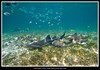
There are not many places with the waters so clear as the ones we see in this area. It´s a pleasure to enjoy the islets from inside the water. these islets gives an unusual landscape to this beach. In the image above we see the islet of S'illa des Bosc, which is located directly across from these shores and that if the currents allow us it can be reached by swimming.
Their sandy areas are quite breathtaking, and sometimes get the feeling that never end, and as we can see in the images the visibility inside water is realy clear in this area, much larger than in other areas of the island, this is due the plant "posidonea" which exists in big amount into this area. The posidonea area combines with other great sandy areas into the sea.
Once we are inside the sea, the water provides to our eyes a blue and white setting. These colors of waters and sands are really beautiful and seem the Caribbean at the Mediterranean. All the frequent readers, who often visit my blog (which I appreciate) know my passion for these beaches, the only thing that I can complain is the large number of people who visit in high season this place, something absolutely normal, because this place is so nice that many people want to enjoy of it.
As they get used to us, the fishes will be coming to us ....
As we see in these images the beauty of the beaches of compte is not only in its landscape outside the sea, but also inside.

August 23, 2013

CALA LLENTRISCA


CALA LLENTRISCA

It´s true that Ibiza now in August is crowded. It is obviously high season. But still are places where we still can find, much as a handful of people, or even less, far of the big crowds, who comes to the Island to enjoy the beautiful beaches of the island. One of these hidden places is Cala Llentrisca.

But to get this we have to roam a long dust lane, from the top of a mountain to the bottom to reach this beach, and certainly we can not drive till here. Some parts of the way, are through some trails that are a bit hard, but because the high temperatures, one can feel harder than it is, anyway it´s also a nice place to visit in winter and much easy.

When we reach here the quiteness is assured, so we find here only some few locals, and some tourists seeking the hidden corners of the island. There also some people who access it by boat, due it is much easier to get here by boat, than to walk.

The boathouses are present throughout the width of the beach, and these tiny buildings is where the local fishermen protect their small boats.

Here there are not modern buildings, restaurants or hotels all around this area, and that is why the forest almost touches the sea. In this cove we find sections with white sand and small pebbles in others, but always with a clear water that allows us to see the bottom.

Who enjoy beach clubs with restaurants, bars and music, this is definetly not their place. On the contrary who enjoys tranquility and nature contact, they will find a place to relax far of the urban places. Here we may live with the few fishermen if they go to sea, and see how they pick up and drop the fishing gear on the beach or in a boat.

This cove is surrounded by a rocky amphitheater that stands behind us and that will protects us from the western wind.

The boats stranded on the sand, give it a color that contrasts with the green of the forest nearby, or the blue or turquoise sea. Definitely a place to enjoy nature.

accessing or leave this place is through a long path that awaits us, but we will be gratified with stunning views of several nearby places. One impressive view is the one to the stunning islets of Es Vedra and Vedranell, that we can glimpse through the woods several times. This is one of the many corners, of the hidden Ibiza..