April 10, 2015

ES FIGUERAL BEACH


PLAYA DE ES FIGUERAL

After a period of "rest", I resume the activity of this blog of Ibiza with one of the most popular beaches on the East side of the island. This is the beach of Es Figueral, and I suppose that the name must reference perhaps, to a large number of fig trees that would be here in this area in the old days.

So the ancient fig trees may have been replaced by the big number of hotels that nowadays have been builded in this area, some huge ones, that are in the vicinity of the beach. It can guess from the pictures, that the beach is of fine sand, ideal for families and for the general public. Here also you can enjoy all amenities like restaurants, bars, sunbeds, lifeguards, showers, pedal boats, windsurfing etc. .....

In the background we can see the island of Tagomago, always present in the northeastern part of the island. These images were taken on this spring season, where still the small population of tourism allows us to enjoy the beaches without the huge number of tourists who will bask in them, within the next weeks.
 
Although this beach has massive attendance during the summer due to the numerous hotels congregated here, also has a wild side, in fact before construction was a isolated and nudist beach, and there are still wild sides that remind us those old days. In one side of the cove there is a kind of natural monolith that some have called as the "finger of God" in likeness of the one in Gran Canaria island (destroyed some years ago by a tropical storm), this one here, is still standing.

In the wild side of the beach, there is a pebble beach, much quieter than the sand side, but limited by a vertical wall that makes shadows on this beach quite early just after midday, so time to enjoy the sun here is quite limited.

It also has some small islets in this area, which reminds us of the nearby beach of aigues blanques.

In short, it's a beach to enjoy, that yes, like all those in the east of the island ideal to enjoy at first thing in the morning as it is when is better to swim and sunbathing. In the afternoon can be partially affected by shadows.
From this beach we can also discern in the distance the beach of "Sa Cala" Sant Vicent, and right next door of it, we can even make out the remains of an old lighthouse, which was replaced by a new one built on the islet of Tagomago.
We must not forget that even in this area will not enjoy sunsets (we are in the East side of the island), it can enjoy some beautiful sunrises, some as wonderful as the famous sunsets on the West side of the island.

March 02, 2015

ARCHEOLOGICAL SITE CANA COSTA (FORMENTERA)

MEGALITHIC FUNERARY MONUMENT OF CA NA COSTA IN FORMENTERA
Quite curious the history of Formentera concerning at their population. For much of its history was uninhabited, but interestingly this monument that really would be a megalithic tomb, dated between 1,900 and 1,600. B.C., which shows that at that time Formentera was already inhabited. Aside Formentera would join the islands of Menorca, Sardinia and Malta which have a large number of megalithic monuments as well as Mallorca with smaller numbers of them, while the enigma remains in the absence of such monuments in the nearby Ibiza that could indicate that Formentera on those ancient times, had greater population than Ibiza itself.
It may not be easy to find this monument, but it doesn't really matter for people with no interest in historic stones, but definitely should matter to others with interest into megalithic. But you can find the monument on halfway to the salinas de Formentera and the little town of Es Pujols. By the way we can see in the explanatory poster, that this monument is known by the inhabitants of Formentera as "es rellotge" (means the clock in ibicenco language).
It looks like a dolmen, disposed in  geometric shape. Despite its long history was discovered in the year 1974, where changed the history of Formentera, so, it was ignored then that Formentera was inhabited in the Punic period, and this showed that long before, civilization had existed. It is curious that in later chapters Formentera remained uninhabited several times, for example when Muslims were expelled for the continuing attacks on the island and shrank its population drastically, even dissapeared.
The place is located surrounded of great natural beauty, and you can see the salt ponds and the "estany Pudent" (a great lake of salt waters). Your visit will not last more than twenty minutes, depending on the interest that could awake in each visitor the history of these stones, which incidentally confirms my idea that Formentera and Minorca are very similar, and among its similarity with the landscape can be add that both islands have megalithic monuments.

September 21, 2014

ES NIU BLAU BEACH

PLAYA ES NIU BLAU
A little gem hidden between Santa Eulalia and Es Canar, a beach of the few ones where one can lie in the shade of the pines, swim in the crystal clear water and has a really clean sand. A beach that once I frequented small and this area left a mark on my memory, when I was playing down these pines (which were somewhat smaller than they are today).
Right next door is the only estuary that exists on the island (although very small indeed), and it seems to be the nature in this area has focused on waters, so not far away there is the mouth of the only river in the insular Spain. 
Of course nothing to do with the famous Galician tions (rĂ­as) which are obviously larger but this one leaves a picturesque corner next to the beach with their small boats moored in the lee of the wind, with the forest surrounding.

The best time to enjoy this beach is in the morning as it is located at the eastern side of the island. In that first hour sunlight, the sun plays with the sea, and reflects off the sea offering a silver white flashes, contrasting with the green of the many pines of the area.

The translation of "niu blau" would be "blue nest", although the predominant color of this beach is the green of the pine trees growing in the sand, but the green also contrasts with the blue sky and sea. A place to enjoy the sun and the shadow of the pines and of course without sunshades.

August 20, 2014

THE NEW WALK AREA IN SANTA EULALIA


NEW "PASEO" IN SANTA EULALIA

The village of Santa Eulalia inaugurated some weeks ago, the new town hall square next to the promenade of the sea, now seems much broader, taking advantage of the space and the great sea views; now it is possible to see the sea from the town hall due the architectonic change of its square. This place is now enjoyed it by its inhabitants and visitors. Santa Eulalia remains being the second largest population of the island, a place where the essence of the island is present. 
 
For this remodel, I'm sure it takes into account the relationship of this town (also known as Villa river) with the water and its river. The water was an abundant good in this area of ​​the island, so, here ends the only river of the spanish islands. Today dry unfortunately (except when it rains).

The traditional irrigation of arab origin, performed and as present in the rural countryside of this island, is represented here by these staggered channels that lead from the city hall to the sea, along the area.

These channels lead us to the sea from the Town Hall, and meanwhile we can begin to enjoy magnificent sea views as we approach the promenade of Santa Eulalia that merges with this new ride at one of its ends.
  
Another of his innovations are the new sources that although there were some sources before, just opposite the Town Hall, now they are much more impressive and have changing lights and can even dance onto the beat of music. Again thanks to the new design of these sources, this square has much more space now..

A classic of Santa Eulalia town is this ancient cistern that have been preserved with the remodeling of this ride and has been not touched, though now without the heavy traffic passing right in front has become a wider pedestrian zone..

They have incorporated some bronze sculptures of something as representative for the island such as the Ibizan hound breed that surely comes from Egypt and was brought to the island by the Phoenicians who had contact with the people of Egypt and they were the first inhabitants of the island . These dogs have become an attraction over this area and are one of the most photographed devices as well as the pixies that are playing near water (their habitat) they also are characters that are closely related to this Villa. The hounds and the elves can also enjoy the sea and the many tourists who walk through the area....
I believe that Santa Eulalia del Rio has become a prime tourist population in Ibiza, which has nothing to do with some bad reputation that sometimes has the island and is that who will visit this town, they will see how people enjoy without need of drinking alcohol all time or drugs, on the contrary, these are people of all ages who enjoy the shops, restaurants and all that this beautiful and unavoidable villa offers..

July 03, 2014

FAMELIARS (ELVES) OF IBIZA


ELVES IN IBIZA

Ibiza is mysterious and magical. Also superstitious, at least a few decades ago Ibiza folks were very surpersticiosos and if something is not lacking in the small island are numerous legends and characters that are real... or maybe not everyone can observe with the naked eye. Elves in Ibiza exist called "fameliars", at least in folklore, and in Santa Eulalia are the most famous ones, as they are a small and strange creatures who live in humid areas and especially under the stone bridge of Santa Eulalia River, is said was built by the devil in one night, in the night of San Juan (from 23 to 24 June) and where with much alacrity that night, when the sun, before rises, and for a few seconds grows an herb called "Grass des fameliar "that if someone catch it properly  and quickly gets inside a glass bottle of black color, in a short time one of these elves appear inside it, and so, we can have it in our home to our service.

To this fameliar or goblin we will must have to procure only two things ... entertain him giving a lot of work, or giving him food. He can eat huge amounts of food and can leave homes completely empty of food and can ruin the inhabitants; although one must be cautious with these creatures and learn to master them, otherwise they may give bad luck. The Fameliars although somewhat naughty,  do not have to be bads, but sometimes they have bad character. They're ugly, yes, with long arms and a big nose, in any case its size is small but with a huge, huge force and it must fit in a glass bottle, usually in a decanter. It's easy to pop it out but you must know to master, giving them work and enough food (but its hard to do it in proper balance) and to go back into the bottle, where there's no danger that run roughshod, we must do so through an olive branch, blessed on the Palm Sunday and say a prayer that over time has been lost, and few people (if any) knows. As an historical curiosity, It is said that in times of the Inquisition, some few people on the island were tried for possessing a fameliar in their home.

There are numerous legends about "fameliars", especially in homes, where when the man who used to be the master of fameliar was absent, the wife was trying to do abuse of the power of the fameliar in the absence of the husband but not knowing properly dominate the troll, also did not know then how to get him back into the bottle, creating chaotic situations that were resolved later when the husband as the owner of the troll, went back home, and had to scold the woman for daring to dominate the fameliar unknowing how to do so, compromising their own integrity and the house as well. There was also a fisherman who always carried the bottle with the troll inside when fishing, with him in his boat so that his wife did not have the temptation to open the bottle and use the fameliar in his absence. Arriving one day to port after fishing, he met two men who wanted to take away her fishing, and because not having much fish as they wanted,  forced the man to go back into the sea to bring more fish for them, so the fisherman opened the bottle and said to the elf  to throw them to the sea, which he did and never the fisherman left the bottle at home, when went to fishing.  Or a girl who had to marry one of her two suitors, one rich and the other poor, she told them that the first one of them to build a house, it would be her husband, and the next day, the poor one, who was owner of a fameliar in a bottle, ordered  the "fameliar" throughout the day  to build a house that ended on the afternoon, and of course the girl married him. When the couple was living there, start happening in it, strange things, and bad luck set the home, after was uninhabited since then, not again dwell never as it seems that misfortune had overtaken there.
The tradition of Fameliars or goblins is famous in many regions around the world. In Ibiza is believed that its origin comes from the Roman period, but perhaps came with those who colonized the island during the period that Ibiza belonged to the Kingdom of Aragon. But these characters not only exist in the Mediterranean, so exist the goblins of Asturias, the gobelins in Normandy, Leprechauns of Ireland, Hobgobins in Scotland, Kobolde in Germany ... etc. Actually they are very popular in Scandinavia and even recently in Iceland, they stopped the construction of a road, due to protests of Icelanders, they demanded to stop the roads due that the areas of the new road affect the place where many elves live. It is possible to read this, on the news by internet.

June 16, 2014

CALA MASTELLA

CALA MASTELLA AND THE POSIDONEA
A tiny beach in size but big on beauty. Lost, so it is a bit confusing the way to get to it. But definitely it´s worth it.
The tiny beach is surrounded by rocks and pine trees, which makes it very attractive. Also in the vicinity is a small harbor with small fishing boats, where we can arrive in a short but lovely walk.
The small beach is sandy, but mostly covered with posidonea. The posidonea due to ignorance is often synonymous with dirt, when in fact the opposite is true. For starters it's not an algae but a marine plant that is found only in the Mediterranean (also called Neptune grass). Ibiza and Formentera have on their seabed, the posidonea great prairies which contributes to the good color of sea water, since this plant oxygenates the seawater. Also on the beach (as we see in the picture above) the posidonea make barriers that prevents water drag the sand, therefore protects beaches and prevents run out of sand. In addition also have advantages, we can walk, jump or lie over it without any danger.
As we move to the small port, very close to the beach we see a landscape of sea, rocks and pine trees with a striking contrast of colors. It´s amazing how some pines arise directly from the rock. We can see here as the cove, almost looks like a estuary, due the incoming water that is surrounded of narrow sea shores. In the background we see an area of ​​reeds and rushes in the main beach, because that area is also the mouth of a small stream during the rainy season.
A small picturesque harbor is situated near the beach, with some local fishing boats. Small docks also harbor small boats waiting to be released out to sea by the owner, who often live nearby.
Fishing gear and proper maintenance of vessels, indicate that are used as fishing boats frequently. From this small port, we can enjoy the best views of the small cove that is opposite. Here the sea has a green or turquoise color that contrasts with the pines at the background. What is not lacking in this place is the incredible quietness all year round.

May 05, 2014

ORCHIDS IN IBIZA

 
WILD ORCHIDS OF IBIZA
Although the name of these beautiful flowers, reminds faraway tropical places such as Costa Rica or Thailand, Ibiza has more than 20 species of native orchids, which are not easy to find. These first three images in this entry, belong to the species of "ophrys fusca" and they found in Mediterranean areas and reaches places as Turkey, Sicily and southern of France. 
 They are wild and protected orchids, so it is totally forbidden to tear them, cut them or to take them,  anyway it's impossible that these beautiful plants can be planted at home because they need the land where they were born, which is almost always the island´s forests.
The kind of "Orphrys Balearica" (picture above and below) is a species found only (as the name suggests) on the Balearic Islands.
Colors vary but not the size, rarely are just over 20 inches high. Interestingly one of the petals resemble the wings of bees and find it much easier to be pollinated. They all bloom the first months of the year, one more reason for visiting Ibiza in winter. In addition to these green and white colors, exist others in yellow, pink, violet and different colors, but they are not easy to find.

April 12, 2014

HOLY WEEK IN IBIZA

CELEBRATIONS OF THE HOLY WEEK IN OLD TOWN (DALT VILA)

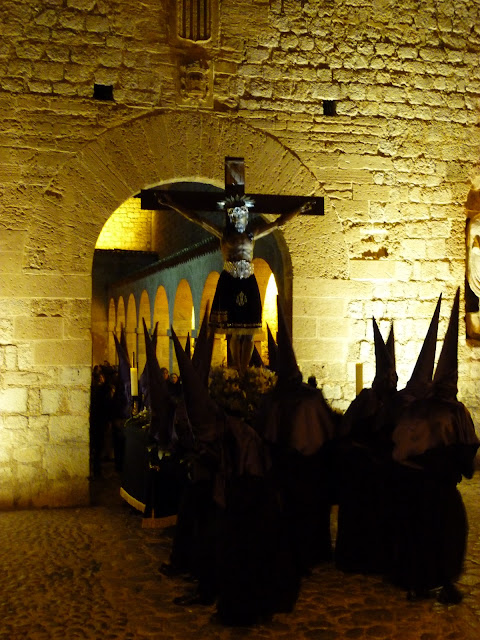
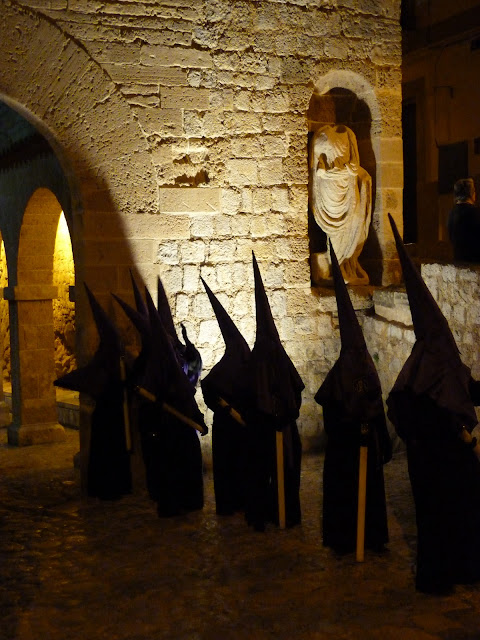
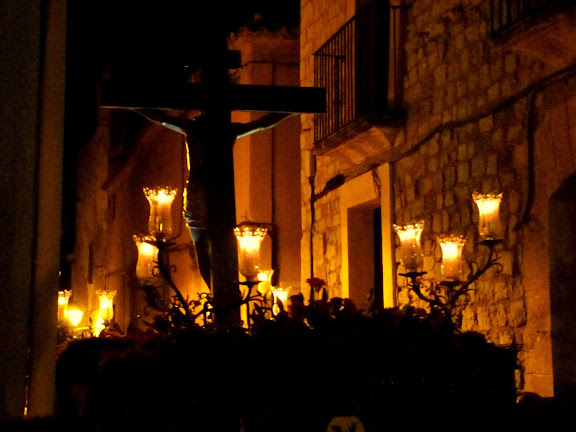
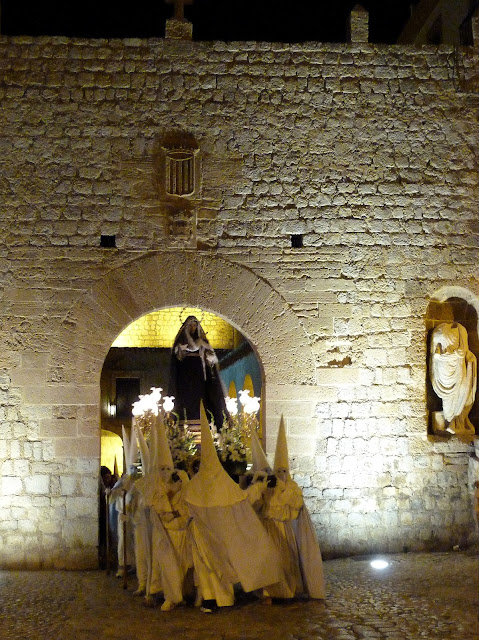
In processions and celebrations the Holy Week of Ibiza is not really popular if we compare with those of Sevilla or Zamora, Valladolid, Murcia or Cuenca, where they are really known. The Holy Week processions in Ibiza are much simpler and not so famous, but have not been few people from many different countries who have told me that they were pleasantly surprised at the beauty of this celebration in such a unique setting as the walled city of Dalt Vila, the ancient old town of Ibiza.

The narrow, winding streets help in this quiet and devotional celebration, and  makes it even more impressive the Good Friday procession in the late evening. Larger images barely fit through some of the narrow streets, so, in these streets, the procession proceeds much slower than in the downtown, newer area, where subsequently the streets become wider. Sometimes in some places the number of public is limited because there is very little place indeed.

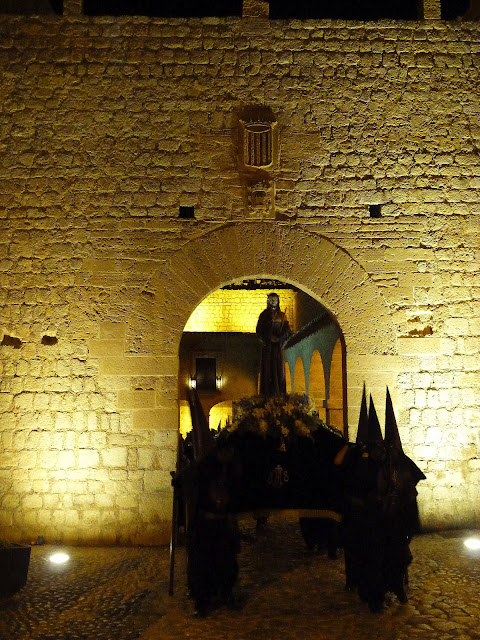
In some parts of the procession, we can enjoy the spectacular backdrop of the ancient city walls. the bible story mix with the history of this city. These ancient walls once defended the walled area of the ancient city that were heavily protected from pirates attacks, and other threats. Perfect backdrop then, for the Good Friday traditional procession that is further enhanced by the beauty of these walls.

During the Holy Week that starts the previous friday  the Good Friday, the streets are the scene of various processions to be held for several specific days,  but the most important is the one which is held on Good Friday evening. The city illuminates their walls to the passage of the different images, ranging through the streets of the city. As I said before, is not the most popular procession of Spain, but may be the one with the most spectacular setting, with its city walls that are among the best preserved in the Mediterranean, and that in 1999 the UNESCO declared World Heritage Site.