Showing posts with label FORMENTERA. Show all posts

October 21, 2016

FIESTAS IN EL PILAR DE LA MOLA

FEAST DAY IN EL PILAR  (LA MOLA) FORMENTERA
On October 12th, the small town of La Mola del Pilar in Formentera celebrated his big day, the day of its patron and therefore people dressed in gala costumes. Although these days have been rainy, the sky during this celebration wore an intense blue color highlighting more the festivity.

The festivities of each parish in the islands of Ibiza and Formentera are familiars, and some of them have some traditional features, in this case to be the Patroness of the village of La Mola is also the Patroness of the Civil Guard who also celebrate their big day, and they are those who take charge of the image in the procession.
The little and white temple remains very small to accommodate the people and tourists who join the celebration. The folks take the images that will participate in the procession through a side door of the church.
The procession starts from the church by the main road and later by the back quiet roads of the population, that pass between centenarian stone walls and fields of Formentera.
The touch of color puts the folk group with its bright colors that  accompany the procession dressed in their finery.
In this festival no shortage of bright colors of the costumes of Formentera that although equal to those of Ibiza have some small difference.
Once the procession ends begin the typical traditional dances that fill with their movements give even more color to this tiny town.
The dances are the same as Ibizans are two islands that unlike the rest of the Balearics have kept the dance, costumes and oldest instruments in the archipelago. As a curiosity the footwear in the traditional costumes of Formentera is usually not like that of Ibiza in the case of women and unlike her sister island, they usually carry different shoes.
Tourists are impressed by the notes of color in traditional costumes, music and dance, and when the dance end, everyone is invited to "oreilletes",  a typical dessert of the island, that maybe has its origins in north Africa, as the Arab heritage is constant in the culture of Ibiza and Formentera. In fact Formentera is the Balearic island closest to the African continent.
Next year on October 12th, same time, same place. 
In the La Mola del Pilar of Formentera, folks will wear their best clothes for their traditional festivities again.

August 07, 2016

MILLS IN SA MIRANDA

WIND MILLS  OF SA MIRANDA IN FORMENTERA
Giants memories of the past, when Formentera was hungry and in these mills that transformed the wheat into bread, thus they were essential in the daily life of this small island.
This "venda of Miranda" (venda, means something like neighborhood) is located on the same side of the capital of the smaller island of the "Pitiusas islands", and its main square is easy to find the street called Sa Miranda or Molins de sa Miranda. At that point is where we can find these gigants stone mills (6 are the antlers of wheat mills in Baleares, like those in Malta, which were identical in design to the Balearic Islands). This area although it seems a great plain, is actually the top of a small hill where with certain intensity blew the wind, reason why there are several of them at this very point. As we see in the picture above, today are relatively surrounded by lampposts and telephone, the result of technological breakthroughs that these mills have seen over the time.
In 1,990 these mills were declared of cultural interest, in the nineteenth century were seven throughout the island, only three remain today with the entire structure including the six blades per mill. These two mills have their names as locals know them by their proper names: Moli d'en Jeroni and Moli d'en Mateu. Although I have previously referred to the nineteenth century as a golden age, some of these mills were already in the eighteenth century, but unfortunately from the 50s of XXth century were falling into disuse.
As clearly seen in  one of them, is privately owned and is within the grounds of a private house, but that does not stop us to see its top, while the other one can be fully seen.
These mills are situated at an altitude of 60 meters above sea level, although not seem high altitude, for Formentera which is a very flat island is enough that they might come the winds to blow and make them work, while the people awaited for the results , I mean from his wheat to subsequently get the bread.

March 02, 2015

ARCHEOLOGICAL SITE CANA COSTA (FORMENTERA)

MEGALITHIC FUNERARY MONUMENT OF CA NA COSTA IN FORMENTERA
Quite curious the history of Formentera concerning at their population. For much of its history was uninhabited, but interestingly this monument that really would be a megalithic tomb, dated between 1,900 and 1,600. B.C., which shows that at that time Formentera was already inhabited. Aside Formentera would join the islands of Menorca, Sardinia and Malta which have a large number of megalithic monuments as well as Mallorca with smaller numbers of them, while the enigma remains in the absence of such monuments in the nearby Ibiza that could indicate that Formentera on those ancient times, had greater population than Ibiza itself.
It may not be easy to find this monument, but it doesn't really matter for people with no interest in historic stones, but definitely should matter to others with interest into megalithic. But you can find the monument on halfway to the salinas de Formentera and the little town of Es Pujols. By the way we can see in the explanatory poster, that this monument is known by the inhabitants of Formentera as "es rellotge" (means the clock in ibicenco language).
It looks like a dolmen, disposed in  geometric shape. Despite its long history was discovered in the year 1974, where changed the history of Formentera, so, it was ignored then that Formentera was inhabited in the Punic period, and this showed that long before, civilization had existed. It is curious that in later chapters Formentera remained uninhabited several times, for example when Muslims were expelled for the continuing attacks on the island and shrank its population drastically, even dissapeared.
The place is located surrounded of great natural beauty, and you can see the salt ponds and the "estany Pudent" (a great lake of salt waters). Your visit will not last more than twenty minutes, depending on the interest that could awake in each visitor the history of these stones, which incidentally confirms my idea that Formentera and Minorca are very similar, and among its similarity with the landscape can be add that both islands have megalithic monuments.

February 14, 2014

CHURCH OF SANT FERRAN DE SES ROQUES

CHURCH OF SAN FERNANDO
ES PUJOLS
In the main tourist resort on the island of Formentera (Es Pujols) this church that has the particularity that it is built of stone outwardly, not follow the architectural canons of being whitewashed in white, like most churches of Ibiza and Formentera due it was built with sandstone. During the Civil War as most religious buildings was severely attacked. It is the smallest of the temples of Formentera. 1.996 In was declared a Cultural Interest site.
But indoors the small temple remains in white, as these architectural rules of the Ibiza and Formentera churches are distinguished, inside the characteristic white both inside and outside the parish. On the main altar, the Image of this Saint of Seville, whom this temple is dedicated.
This parish was created in 1785 with the creation of parishes, and due to a decree regulating the creation of a third parish in Formentera, on the salt ponds (although not to be built in that area, due the weakness of the land and building was later  this church in its present location) was begun in the year 1853 although the cult began in 1889, although since 1785 the neighbors could hear the mass in a chapel dedicated to Saint John.

October 02, 2013

THE ROMAN ROAD IN FORMENTERA

"SA PUJADA" DE FORMENTERA
Among the islanders is known as "Sa Pujada" the Roman road that in remote times was the only access to the top of the Mola in Formentera. A natural espace in the woods by a historic road on the island of Formentera and with views that will amaze us.
The road does not have too much difficulty, actually is a slope through thick forest during a while and after when it becomes no so thick, lets us see a breathtaking view of the island. It is ideal for an overcast day where we can not enjoy the beach (eg.).
During this way we will see the cliffs on different heights, due the road is always passing near the coast, and in some scraps the way is on a quite considerable height. We're going down to the tourist area of ​​Es Calo. This road in antiquity was much larger than the scrap that remains today of this ancient road.
In December 1993 this road was declared " Bien de interés cultural" (merit of cultural interest) on category of monument.
During our walk we can see amazing things as an old well which dates from 1889. The wells are a constant in this island, where the rain water is a treasure. As a curiosity it is noteworthy that as decor has a plate with the name of Formentera but the picture belongs to a woman with the tipical attire of "Mallorca".
Once at Es Calo if the weather is with us we can take a dip, although the particular day I did not accompany me in the route,. So once reach the sea I was prepared to go back to the top again, although is more complicated, so this time I have to climb up the hill. Anyway I really recommend this route, as contact with nature is assured and the stunning views can be enjoyed from this path.

May 17, 2013

FIG TREES IN FORMENTERA

FIG TREES OF FORMENTERA
This entry is dedicated to these trees that exists in big number in both Ibiza and Formentera. But it´s in Formentera may be, due to that dry land that the size of these tree have huge dimensions and is easy to see it. Not only the size of the tree will draw to the traveler attention but also with which careful dedication of the land owners care the tree branches in order to not reach the ground, placing them props for the branches not to fall and rise above ground level.
The fig tree is a tree biblical, which already is an example of resurrection, as in winter the tree looks died, and only we can see their bare trunks during its rest, but in summer lives again, from the spring, where suddenly transforms into a green plant with its huge green leaves covering the tree and also offers its delicious fruits, the figs..
winding brunches are visible to those who will approach these trees, although not need more care than those whose owner don´t want them their branches are off the ground (so it will be much easier to be picked up the fruit), for this tree so resistant that also will offer some delicious figs and also a welcome shade in the countryside, while all around exists the burning sun of summer season, here both people and animals usually rest under the tree shadow, where often many sheeps and goats grazing on the island have their rest on midday.
Some centenarians fig trees became very popular on the island. Some of them were underpinned by over 200 braces, in this case would be the famous fig tree, of Formentera, a tree that some decades ago became a legend, and although I have searched I have not found it (yet), or maybe I've seen it and did not know it was that one; the truth is that in any of the roads of Formentera is located with authentic giants specimens of figtrees. In any case it is hard to understand how the most famous icon of Formentera are the lizards (which are beautiful and very abundant) and has put aside this tree that is a true symbol of this island.

December 17, 2012

CHURCH OF SAN FRANCISCO IN FORMENTERA

CHURCH OF SAN FRANCISCO JAVIER IN FORMENTERA
On December 3 Formentera celebrates the feast of Saint Francis Xavier (San Francisco Javier) and the main church of Formentera is dedicated to him. Simple as the island itself, this church stands in the middle of the largest population of the small island. White walls inside this temple and architectural features as churches of the pitiusas, and very big looking outside, reminding us that, even built as a temple when the anxieties of Berber incursions were about to end, it could still have been used as a fortress against these dangerous attacks in case of need to do so.
By then, on the island there was only one place of worship, was the small chapel of Sa Tanca Vella, and early on the eighteenth century it was decided by the Archbishop of Tarragona, from which depended the churches of Ibiza and Formentera, build a large church and that was performed on the year 1726, with the collaboration of all the inhabitants of the island. The main altar we see today (pictured above) was added after the Civil War since the original was burned during the war.
The Church today is located in the middle of the main square of the town of Sant Francesc, and in front of the small council. A beautiful square which is the main meeting place for tourists and locals. A small and limed well it gives local charm, and next to it, we can see the ancient and massive defensive walls of the church.
And of course, we also see the calvary (set of three crosses that are usually at the entrance of churches of Ibiza and Formentera) at the outside white wall. Formerly the exterior walls of the church were not painted, so it had a hard aspect of a large grey building, currently whitewashed in its main facade. All this turns in a much more Mediterranean look, and it gives a especial atmosphere to all the square.

June 18, 2012

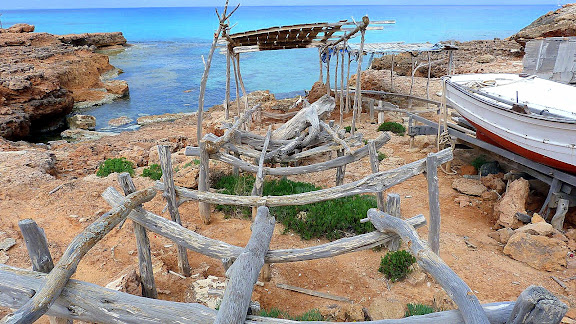
DOCK WOODS IN FORMENTERA

 
VARADEROS IN FORMENTERA
 
Draws attention both: its fragility and its situation on most occasions, due they are located in where you least expect them. Isolated on the rocks with nothing around, there are these little docks where local fishermen retain on the land, their small boats.
 
Their fragility is striking, although the Mediterranean sea almost always is calm, severe storms sometimes arise in a short time and are very aggressive so tend to destroy everything in its path, as the more fragile things. Perhaps that fragility of these varaderos, does as the bamboo canes do with the wind, bend, but not break.
 
So at open air and over a rocky place, these small boats will wait for the owner to go back to sea in a fishing day, where the sailor hopes to provide a good basket of fish to home, and after enjoy dinner or lunch with family or friends.
 
These docks (in the pictures) are located very close to the beautiful white sand beach that is located on the northwest coast of the island of Formentera and known as "Cala Saona." A walk through reddish rocks lead us to this small bay where we will run into these fragile-looking wood, that seems improvised small docks and boats that are in absolute isolation and there, boats will expect their owners for sail together on the old "Mare Nostrum".