Showing posts with label SANTA EULALIA. Show all posts

May 16, 2016

CALA PADA

CALA PADA
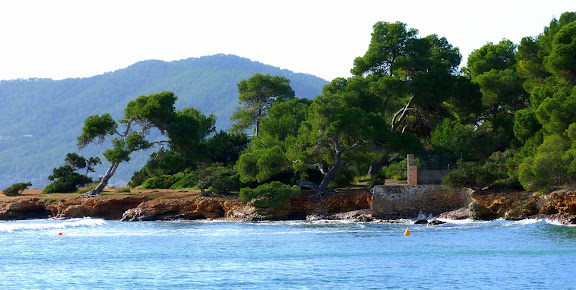
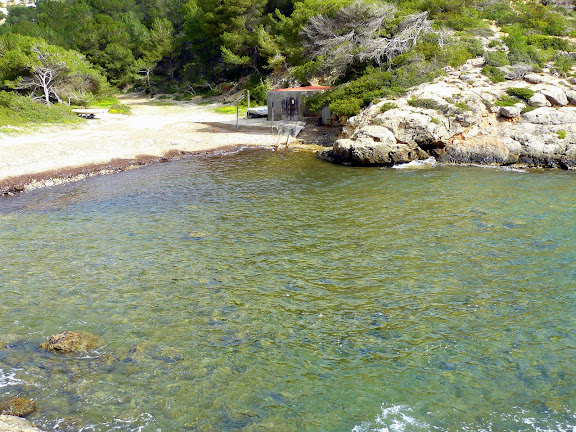
Located few kilometers from Santa Eulalia, between Santa Eulalia and the Es Canar tourist resort, we can find this beautiful cove of white sand and surrounded by pine trees. Surrounded by few bars and some hotels which are outside from the beach and make it a familiar and quiet beach.
Perhaps the pier (that sometimes serves as a makeshift trampoline to jump directly into the sea) is one of the most remarkable things about this quiet beach.
This beach is ideal for families since the water is not very deep and it is usually protected from the winds. It is not a very large cove as it has a length of 200 meters.
Now in spring,  but also in autumn and on winter, it is great  for a sunbathe, because during summer is much more busy, but the rest of the year usually is very quiet.
Some of the pines surrounding the beach have the shape the wind is sculped on them, adding the green color into the landscape that contrasts with the blue of the crystal clear waters of this beach, in addition to the native pine trees also this beach has some palm trees giving you a tropical touch.

September 21, 2014

ES NIU BLAU BEACH

PLAYA ES NIU BLAU
A little gem hidden between Santa Eulalia and Es Canar, a beach of the few ones where one can lie in the shade of the pines, swim in the crystal clear water and has a really clean sand. A beach that once I frequented small and this area left a mark on my memory, when I was playing down these pines (which were somewhat smaller than they are today).
Right next door is the only estuary that exists on the island (although very small indeed), and it seems to be the nature in this area has focused on waters, so not far away there is the mouth of the only river in the insular Spain. 
Of course nothing to do with the famous Galician tions (rías) which are obviously larger but this one leaves a picturesque corner next to the beach with their small boats moored in the lee of the wind, with the forest surrounding.

The best time to enjoy this beach is in the morning as it is located at the eastern side of the island. In that first hour sunlight, the sun plays with the sea, and reflects off the sea offering a silver white flashes, contrasting with the green of the many pines of the area.

The translation of "niu blau" would be "blue nest", although the predominant color of this beach is the green of the pine trees growing in the sand, but the green also contrasts with the blue sky and sea. A place to enjoy the sun and the shadow of the pines and of course without sunshades.

August 20, 2014

THE NEW WALK AREA IN SANTA EULALIA


NEW "PASEO" IN SANTA EULALIA

The village of Santa Eulalia inaugurated some weeks ago, the new town hall square next to the promenade of the sea, now seems much broader, taking advantage of the space and the great sea views; now it is possible to see the sea from the town hall due the architectonic change of its square. This place is now enjoyed it by its inhabitants and visitors. Santa Eulalia remains being the second largest population of the island, a place where the essence of the island is present. 
 
For this remodel, I'm sure it takes into account the relationship of this town (also known as Villa river) with the water and its river. The water was an abundant good in this area of ​​the island, so, here ends the only river of the spanish islands. Today dry unfortunately (except when it rains).

The traditional irrigation of arab origin, performed and as present in the rural countryside of this island, is represented here by these staggered channels that lead from the city hall to the sea, along the area.

These channels lead us to the sea from the Town Hall, and meanwhile we can begin to enjoy magnificent sea views as we approach the promenade of Santa Eulalia that merges with this new ride at one of its ends.
  
Another of his innovations are the new sources that although there were some sources before, just opposite the Town Hall, now they are much more impressive and have changing lights and can even dance onto the beat of music. Again thanks to the new design of these sources, this square has much more space now..

A classic of Santa Eulalia town is this ancient cistern that have been preserved with the remodeling of this ride and has been not touched, though now without the heavy traffic passing right in front has become a wider pedestrian zone..

They have incorporated some bronze sculptures of something as representative for the island such as the Ibizan hound breed that surely comes from Egypt and was brought to the island by the Phoenicians who had contact with the people of Egypt and they were the first inhabitants of the island . These dogs have become an attraction over this area and are one of the most photographed devices as well as the pixies that are playing near water (their habitat) they also are characters that are closely related to this Villa. The hounds and the elves can also enjoy the sea and the many tourists who walk through the area....
I believe that Santa Eulalia del Rio has become a prime tourist population in Ibiza, which has nothing to do with some bad reputation that sometimes has the island and is that who will visit this town, they will see how people enjoy without need of drinking alcohol all time or drugs, on the contrary, these are people of all ages who enjoy the shops, restaurants and all that this beautiful and unavoidable villa offers..

April 06, 2014

SANTA EULARIA DES RIU

SANTA EULALIA DEL RÍO
Santa Eulalia is the second most important city after the capital of the island and where the main square is located the town hall, built in ibicencan style and very close to the promenade in front of the sea with their nice gardens. 
The promenade of this village, is one of the most joyful and beautiful of the island. And this could be also due the beaches that surround it, its marina and even the mouth of the river, the only one that exists off the mainland of Spain, all of this, makes this place something special..
Santa Eulalia was the first town on the island to dedicated a monument to the countryside women. Nowadays, still are some of them working at the countryside but some decades ago all of them were working the land, or others who were mending fish nets of their fisher husbands.
In the same square where is the monument to payesa, but on the other side we can see a curious barrel, that does not have any history link with the population, except a sinking in the seventeenth century of a boat carried it onboard and that sank in front of the town. This barrel was made in Naples in 1650 and is decorated with the arms of Philip IV of Spain.  
Other of the historic buildings of Santa Eulalia is your theater called Teatro España. There were only two theaters on the island, the Pereyra theater can still be seen the old façade today in the capital city of Ibiza, and this one at the above image, Teatro España.
We continue walking along the promenade of the town, where water sources are confused with the water of the Mediterranean Sea .... Not far from where the river has its mouth, so the water in this city is very important.
Walking through this ride can enjoy the buildings that exist right front of the sea, and the bars, restaurants, and entertainment places, that exist in the low of these buildings, we find here a pleasant surprise ...
...like this waterwheel in Ibiza, there were a lot in the island but nowadays are dwindling, and remind us of ancestral forms of irrigated fields of the island. Here still survives, pretty neat and contrasts with the modernity of the surrounding buildings.
But one of the most important and popular places of the Santa Eulalia Town is for its "Puig de Missa" (Mass Mount), and is crowned by the main church of the town. As we ascend some nice views of the river liven up the walk, watching irrigated fields near the old river.
In Ibiza there are two "Puig de Missa" the Santa Eulalia is perhaps the best known and the other is in the town of San Miguel. In both cases the temples were ancient fortifications to repel the dangers that lurked on the island from attacks by pirates or other criminals and that is easily visible by towers and defensive walls.
Before reaching the temple we went through a few narrow streets where today are what they were small white houses yesterday and were very old village houses next to the church.
Formerly the houses that were built in town, were made near churches by the need to take refuge in them, in case of invasion.
The tower behind the temple show the defensive nature that he had at other times the church of Santa Eulalia. The name Santa Eulalia is in relation to this population since 1276 although this temple was built in 1560, replacing an earlier temple destroyed by a Turkish attack was destroyed in the year 1543, which was also dedicated to Santa Eulalia a Saint who lived in Barcelona.
This temple was built on same time that the walls in the city of Ibiza, and artillery was ready to use in case of combat. The bastion at the back of the church is visible in the image below, this bastion was well equipped with guns and ready to defended the zone of the mouth of the river and some old mills that existed then. With the exception of this bastion the rest of the temple is in white lime following the precepts of the religious temples of the island.

October 25, 2012

THE RIVER OF SANTA EULALIA

EL RÍO DE SANTA EULALIA
Autumn has come, now there are less tourists and it's time to start doing some winter hiking. This is another thing. Tourists who remain are the ones that comes here lifetime, those who know the island well, and they don´t want to come in July or August to avoid overcrowding mass. So today is the day to visit the Santa Eulalia´s River, the only river that exist out the spanish mainland.
Here we find a bridge (although there are many) and is located in a very nice area. It´s named as Pont de Can Font, and pass down the old way of Labritja. Today the municipality of Santa Eulalia (second largest population center of Ibiza) decided to leave a plaque to remember the ancient history of this road.
To get to the Pont de Can Font at this time of year, we must go by a torrent full of weeds and reeds with leaves that we must be aware, because they can cut like a knife .... This river in Roman times was named as River Valcar .
From one of the shores out of the River, we can see from afar the "Puig de Missa" in Santa Eulalia. A small hill crowned by the main church of the population, as well as several white houses that surround it. We can also see an old water mill in other side, and to top it all in a natural setting with an enviable tranquility..

November 04, 2011

MILL IN PUIG DEN VALLS


THE MILL OF PUIG D´EN VALLS

Simple architecture, as anything ancient on the island, whether churches, houses or these nice old windmills that allowed people to grind the wheat and eated bread, in times where there were more scarce goods than at present. This mill is located at the top of a "puig" (hill) just opposite the city of Ibiza which is also a hill and is the oldest part of town known as Dalt Vila.

Unlike the popular windmills of La Mancha (in the spanish mainland) these ones in Ibiza have two more poles, a total of six, like the rest of the neighboring islands, although I must say that both Ibiza and Formentera are the simplest of the Balearic Islands due the lack of housing as a larger square at its base as it happens in Mallorca and Menorca, making them much larger than these ones in Ibiza and Formentera. This discreet but beautiful mill is not used anymore from the civil war, but milling wheat from its construction even before the year 1800s.

April 22, 2010

CALA ESPART


CALA ESPART


I must admitted that I did not know this cove that kept it as a secret, I discovered in some corner of my island.

Surrounded by pine trees and crystal clear water. It reminds me of some of these beaches not crowded at all in Menorca.

A kind of small river of sea water takes us on a rocky stretch to the beach and assures us that most of the year has very calm waters. Depends on the time it will be embellished with flowers or simply by the awesome blue Mediterranean Sea.

The pines gives a green touch to this cove that contrast with the color of the rocks and blue sea. A few yards from the cove there are some caves where some fishermen leave their boats refugees, until the return to the sea.