April 12, 2014

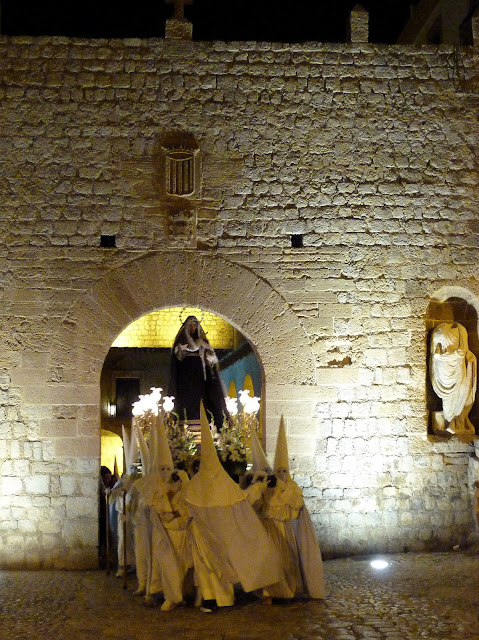
HOLY WEEK IN IBIZA

CELEBRATIONS OF THE HOLY WEEK IN OLD TOWN (DALT VILA)
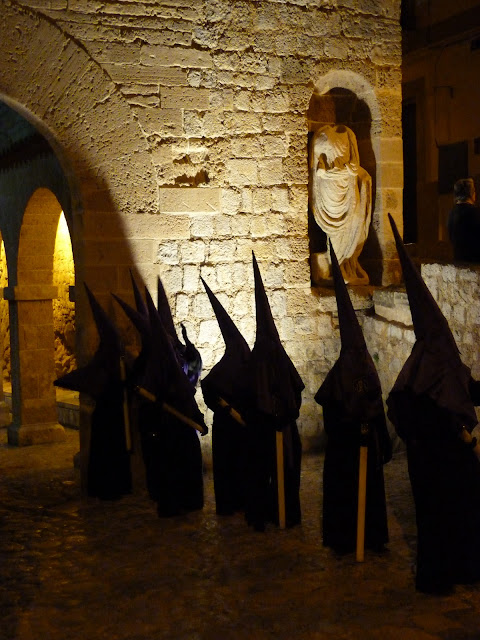
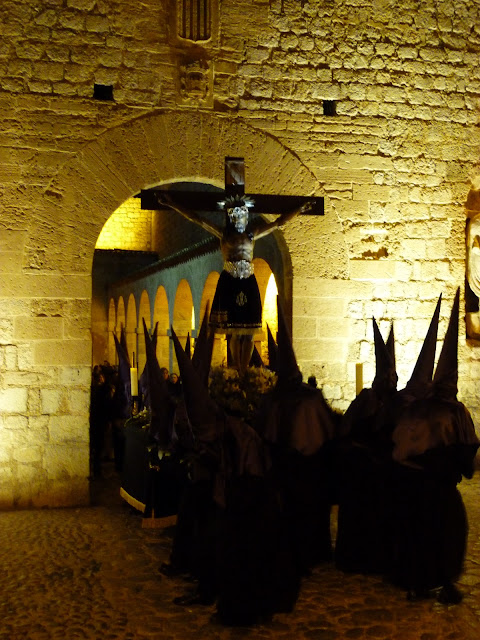
In processions and celebrations the Holy Week of Ibiza is not really popular if we compare with those of Sevilla or Zamora, Valladolid, Murcia or Cuenca, where they are really known. The Holy Week processions in Ibiza are much simpler and not so famous, but have not been few people from many different countries who have told me that they were pleasantly surprised at the beauty of this celebration in such a unique setting as the walled city of Dalt Vila, the ancient old town of Ibiza.

The narrow, winding streets help in this quiet and devotional celebration, and  makes it even more impressive the Good Friday procession in the late evening. Larger images barely fit through some of the narrow streets, so, in these streets, the procession proceeds much slower than in the downtown, newer area, where subsequently the streets become wider. Sometimes in some places the number of public is limited because there is very little place indeed.
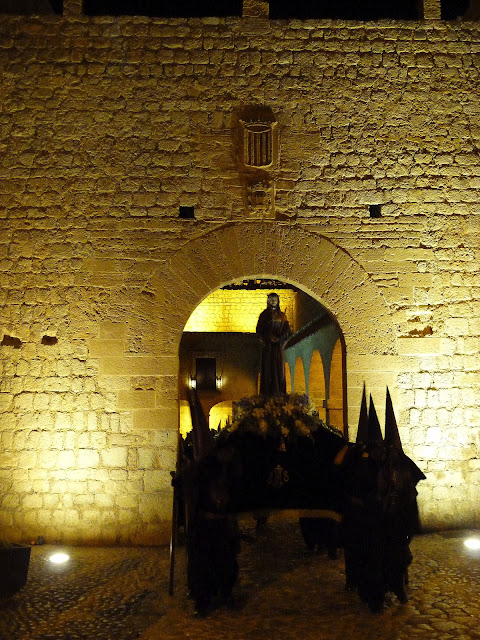
In some parts of the procession, we can enjoy the spectacular backdrop of the ancient city walls. the bible story mix with the history of this city. These ancient walls once defended the walled area of the ancient city that were heavily protected from pirates attacks, and other threats. Perfect backdrop then, for the Good Friday traditional procession that is further enhanced by the beauty of these walls.
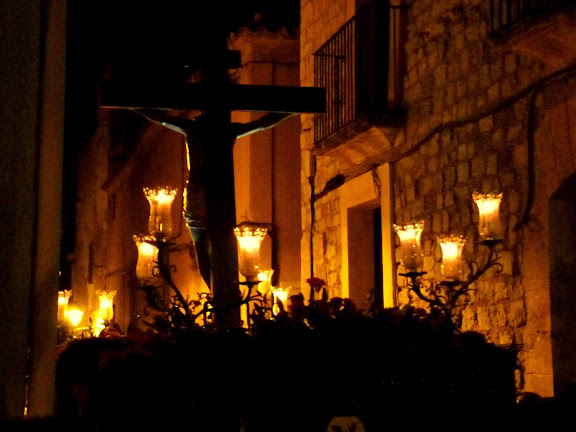
During the Holy Week that starts the previous friday  the Good Friday, the streets are the scene of various processions to be held for several specific days,  but the most important is the one which is held on Good Friday evening. The city illuminates their walls to the passage of the different images, ranging through the streets of the city. As I said before, is not the most popular procession of Spain, but may be the one with the most spectacular setting, with its city walls that are among the best preserved in the Mediterranean, and that in 1999 the UNESCO declared World Heritage Site.
April 06, 2014

SANTA EULARIA DES RIU

SANTA EULALIA DEL RÍO
Santa Eulalia is the second most important city after the capital of the island and where the main square is located the town hall, built in ibicencan style and very close to the promenade in front of the sea with their nice gardens. 
The promenade of this village, is one of the most joyful and beautiful of the island. And this could be also due the beaches that surround it, its marina and even the mouth of the river, the only one that exists off the mainland of Spain, all of this, makes this place something special..
Santa Eulalia was the first town on the island to dedicated a monument to the countryside women. Nowadays, still are some of them working at the countryside but some decades ago all of them were working the land, or others who were mending fish nets of their fisher husbands.
In the same square where is the monument to payesa, but on the other side we can see a curious barrel, that does not have any history link with the population, except a sinking in the seventeenth century of a boat carried it onboard and that sank in front of the town. This barrel was made in Naples in 1650 and is decorated with the arms of Philip IV of Spain.  
Other of the historic buildings of Santa Eulalia is your theater called Teatro España. There were only two theaters on the island, the Pereyra theater can still be seen the old façade today in the capital city of Ibiza, and this one at the above image, Teatro España.
We continue walking along the promenade of the town, where water sources are confused with the water of the Mediterranean Sea .... Not far from where the river has its mouth, so the water in this city is very important.
Walking through this ride can enjoy the buildings that exist right front of the sea, and the bars, restaurants, and entertainment places, that exist in the low of these buildings, we find here a pleasant surprise ...
...like this waterwheel in Ibiza, there were a lot in the island but nowadays are dwindling, and remind us of ancestral forms of irrigated fields of the island. Here still survives, pretty neat and contrasts with the modernity of the surrounding buildings.
But one of the most important and popular places of the Santa Eulalia Town is for its "Puig de Missa" (Mass Mount), and is crowned by the main church of the town. As we ascend some nice views of the river liven up the walk, watching irrigated fields near the old river.
In Ibiza there are two "Puig de Missa" the Santa Eulalia is perhaps the best known and the other is in the town of San Miguel. In both cases the temples were ancient fortifications to repel the dangers that lurked on the island from attacks by pirates or other criminals and that is easily visible by towers and defensive walls.
Before reaching the temple we went through a few narrow streets where today are what they were small white houses yesterday and were very old village houses next to the church.
Formerly the houses that were built in town, were made near churches by the need to take refuge in them, in case of invasion.
The tower behind the temple show the defensive nature that he had at other times the church of Santa Eulalia. The name Santa Eulalia is in relation to this population since 1276 although this temple was built in 1560, replacing an earlier temple destroyed by a Turkish attack was destroyed in the year 1543, which was also dedicated to Santa Eulalia a Saint who lived in Barcelona.
This temple was built on same time that the walls in the city of Ibiza, and artillery was ready to use in case of combat. The bastion at the back of the church is visible in the image below, this bastion was well equipped with guns and ready to defended the zone of the mouth of the river and some old mills that existed then. With the exception of this bastion the rest of the temple is in white lime following the precepts of the religious temples of the island.

March 25, 2014

CARNIVAL IN IBIZA

LA RÚA DE CARNAVAL
CARNIVAL IN THE STREETS OF IBIZA 

Boundless imagination, streets full of color and choreography, and even laughter or moments for reflection because sometimes the features exposed by the people who participate are present characters, although there are also classics that are a must in a carnival.

Ibiza in carnivals can not compete with Rio de Janeiro, nor Tenerife, but there is no doubt that the streets are animated and filled with colorful with the cavalcade of this popular and local carnival held every year on Carnival Sunday. And the proof: these images that show that imagination and ingenuity are not lacking. From the Disney classics like The Lion King, where they staged a spectacular choreography.

And also the  Latins rhythms, percussion and dance during the hours-long parade, that passes through the main streets of the city. In the picture a group who brought to Ibiza, the island rhythms of Cuba.

The word "Carnival"  is always linked with Brazil, so there is always some Brazilian reminiscent, also here in the Carnival of Ibiza, which is quite international. Anyway the temperatures in February in Ibiza are a bit differents from the carioca country, but fortunately this year we were lucky, and the sun shone the whole time on the parade.

Ibiza´s carnival also mention some issues of the island. Here the huge parade of urchins, a very ibicenc animal that becomes every time less usual in the island fields. This is a tribute to this animal that is almost made of thousands spikes.

The aviation was present on several occasions, and in this participation there were  various colored planes made of baloons, which was dedicated to the 40 airmen. A very "retro" fashion and features.

This one was also about aviation, and to the fashion, was included a live music concert with a wonderful coreography.

Egypt, the ancient and powerful Egypt was also present into the Ibiza streets, the group performed on a spectacular choreography and very colorful costumes of the ancient Egypt era.

The carnival of Venice is worldwide famous. For those who could not go there this time, a group brought the Venice carnival here, a group dressed with elegant costumes through the city.

the imagination in carnival is very vast indeed, and also the characters in stories have their place here. Kings, princes, soldiers, maids.... etc. In the picture above the members of an association recreates the story of "Rapunzel".

The great classics are also present here, although the day was beautiful and very very sunny, a huge group performed the "singing in the rain", so the umbrellas this time were useful for the spectacular coreagrafia that these young people did.

The Carnival says goodbye, until next year, when the next carnival Sunday 2015 will be held once more, this parade through the Ibiza streets offering colourful and happiness.

February 25, 2014

SA COVA DES VI

SES FONTANELLES
 The Cova des ví (wine cave) makes reference, to that was used to store wine mainly due to the qualities of the cave to preserve the wine. This occurred in the early twentieth century and also vinyards were planted in the nearby meadows.
Located on the cliffs of Cap Nonó also called Nunó, this cave is within in the Ses Fontanelles area, and the only cave paintings found in Ibiza are into this cave. Anyway the paintings not clarify the motives and the meanings and so, the researchers do not agree even on dates of these ancient drawings.

The cave is located about 40 meters high on a cliff with access from inland, and there is another access from the sea. the inland way, it is relatively close to the beach of Cala Salada and the nearby cliffs create beautiful landscapes.
The cave paintings are schematic drawings, and do not yet known its interpretation or meaning. They appear very similars to the drawings in a cave in Sicily, although these of Sicily is known they belong to the Punic period. These paintings were discovered by a French abbot in 1917, and he thought, that were a drawing of boats and they were prehistoric, and he pointed that dates back to around the year 1000 BC. Although I must insist that the experts fail to reach an agreement on the chronological significance of the paintings, which could be of the same period of the drawings of the Punic period of the cave in Sicily.
In any case, there is no doubt that although not worth maybe get there for the paintings themselves, it is for its scenery surrounding the cave, which has as a background the nearby sea, in contrast to the rocks or the bushes..
If we watch up, above us, this vertical wall of impressive cliffs, we may think it will fall over us. Really impressive....
And although this cave is surrounded by greenery by on one side, the other we can see the impressive and immense stone wall, that get lost into the heights.
If we wish to extend our route, we can go down to the sea by a stone staircase, and there, very close to the sea level, we will find the cave de Ses Fontanelles (sometimes is confused with the name given to the before mentioned cave), the Cave de Ses Fontanelles has a natural water birth.
Once upstairs again, from were we started to go down to the cave, we can take another path surrounding the "Puig Nono" that will take us to the village of Santa Agnes de Corona, and as we travel, on the way and close to the road, we can admire ancient lime kilns or abandoned farm houses.

February 14, 2014

CHURCH OF SANT FERRAN DE SES ROQUES

CHURCH OF SAN FERNANDO
ES PUJOLS
In the main tourist resort on the island of Formentera (Es Pujols) this church that has the particularity that it is built of stone outwardly, not follow the architectural canons of being whitewashed in white, like most churches of Ibiza and Formentera due it was built with sandstone. During the Civil War as most religious buildings was severely attacked. It is the smallest of the temples of Formentera. 1.996 In was declared a Cultural Interest site.
But indoors the small temple remains in white, as these architectural rules of the Ibiza and Formentera churches are distinguished, inside the characteristic white both inside and outside the parish. On the main altar, the Image of this Saint of Seville, whom this temple is dedicated.
This parish was created in 1785 with the creation of parishes, and due to a decree regulating the creation of a third parish in Formentera, on the salt ponds (although not to be built in that area, due the weakness of the land and building was later  this church in its present location) was begun in the year 1853 although the cult began in 1889, although since 1785 the neighbors could hear the mass in a chapel dedicated to Saint John.