November 28, 2011

CHURCH OF SANT MATEU


SANT MATEU D´AUBARCA CHURCH


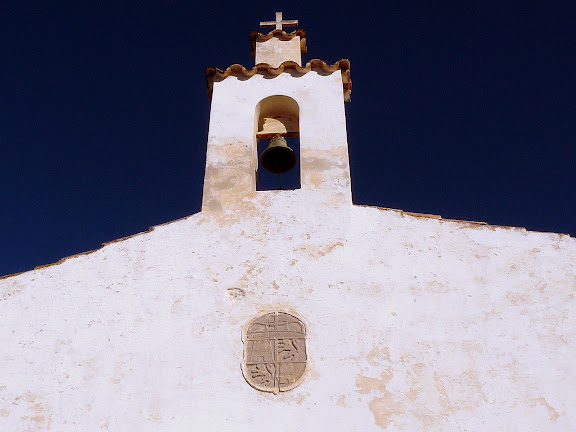
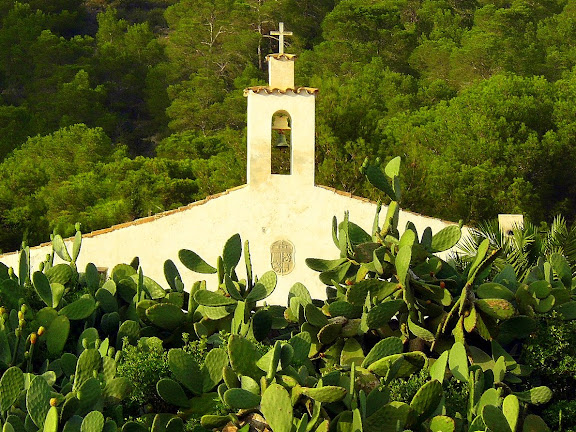
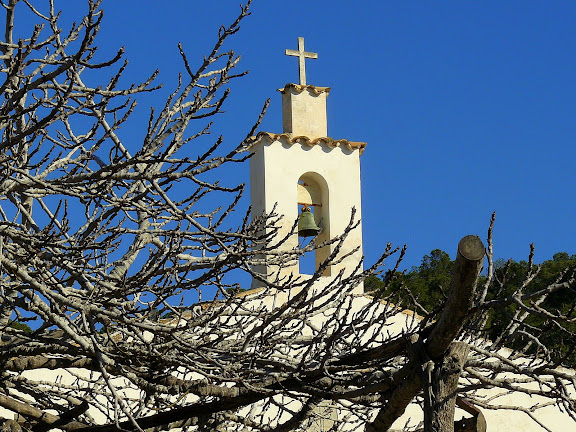
Following the aesthetic canons regarding the rural Ibiza churches, this church Sant Mateu is the strictly enforced. White walls. Although being built in the eighteenth century its use was only religious and not defensive as those of Sant Antoni, Sant Miquel, Sant Jordi and Santa Eulalia that were built much earlier and its use was defensive. A sample of its white walls is the picture above, in which case, you can see that is one of the few churches that has retained its traditional pulpit (already disappeared in many others), and which is now fully disused.

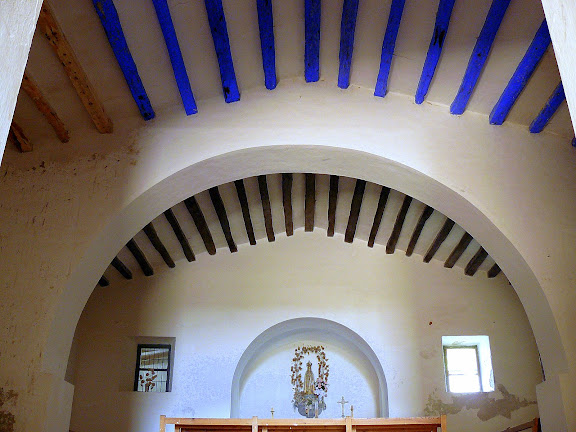
At the center of the altar, the image of Saint Matthew which is held every September 21st. On either side an image of the Virgin Mary and St. Michael. The altar has blue and gold touches. The original was destroyed and probably burned in the civil war of 1936 like many others on the island.

At the back side of the church and contrasts with the pure white walls of this little temple is a small colorful stained glass of St. Matthew, who according to the tradition was evangelist and apostle and before that tax collector, a task that has little to do with the two others. Its iconography is represented by the figure of a winged man.En

Once back to outside we see again the importance of the whitewashed walls, contrasting with black crosses, the Way of the Cross (known as via crucis) and the Calvary (set of three crosses together that exists in all rural churches of Ibiza) which are located on the porch of this church. This porch already belongs to the nineteenth century, and was vital to guard visitors and mass assistants against the bad weather before and after church services, also was an important meeting point for the population as the houses were at very far distance from one each other. This church is a small temple not for its importance but for its simplicity and beauty it is worth pausing a moment and enjoy those whitewashed walls, that one day gave the island the nickname of White Island, in addition to being located surrounded by pine trees, vines, carob trees and a large area of ​​crops typical of the island and of great natural beauty. Not forgetting the wine festival now held early in the month of December due San Mateo is one of the largest producers of both vine and wine of the island.


November 17, 2011

TWILIGHT IN SANT ANTONI


AUTUMN TWILIGHT IN SANT ANTONI DE PORTMANY

This former fishing village has undergone a brutal metamorphosis in the last 40 years. But accustomed to extreme changes also, completely changes from summer to winter offering two completely different faces. Also its image, what was the big tourist attraction and the first arrival of a respectful and polite tourists to the island by Sant Antoni in the seventies, today is the shame in many aspects of the locals and in tourism since the model is actually the model not to follow for any destination wishing a good image for itself, and (that´s the worst) with the approval of some local politicians who look the other way this big problem.


Loud noises, screaming, and drunk tourists of a part of the visitors in this town in summer are now over, and give way to a complete calm in winter and now is hard to remember the bad image of this place (well deserved in other side) that has the people. And it's not for lack of means, as Sant Antoni could be (as it already was) the best destination in Ibiza. Proof of this is the bay that is by far the most beautiful on the island. Another is its port, which along with the town skyline as seen in these images could be an idyllic vacation spot for all audiences (as was, in the past). In any event, Sant Antoni´s sunsets are unique, perhaps even better in winter than in busy summer.

November 04, 2011

MILL IN PUIG DEN VALLS


THE MILL OF PUIG D´EN VALLS

Simple architecture, as anything ancient on the island, whether churches, houses or these nice old windmills that allowed people to grind the wheat and eated bread, in times where there were more scarce goods than at present. This mill is located at the top of a "puig" (hill) just opposite the city of Ibiza which is also a hill and is the oldest part of town known as Dalt Vila.

Unlike the popular windmills of La Mancha (in the spanish mainland) these ones in Ibiza have two more poles, a total of six, like the rest of the neighboring islands, although I must say that both Ibiza and Formentera are the simplest of the Balearic Islands due the lack of housing as a larger square at its base as it happens in Mallorca and Menorca, making them much larger than these ones in Ibiza and Formentera. This discreet but beautiful mill is not used anymore from the civil war, but milling wheat from its construction even before the year 1800s.

October 31, 2011

END OF SUMMER IN CALA D´EN BASTER


AWAITING THE GOOD WEATHER IN CALA DEN BASTER

Although seems that this year will cost much more to do so, but the winter season already is here. Now days are getting shorter and longer and cold at nights are more comun, although during the day temperatures are still quite warm. The beaches and coasts are increasingly showing up again deserted and the quiet winter is appearing along the coast.

In Formentera exists a small and charming cove called Cala En Baster or Cala den Baster, I prefer the second name. There is little sand, some rocks and when the waters are calm is a good place to take a dip.

The most significant of the this creek are caves made ​​by the hand of man, especially by sailors to "park" their small fishing boats. During the summer are daily sailing the nearby waters, but when winter comes, then they hibernate in their caves, as well as those famous lizards hibernate in winter in Formentera.

The long timbers that are used to carry boats to the sea, now are falling apart with the force of the sea, the boats begin to rust, but in spring it will remove the rust that has produced winter inactivity, will be re-painting and getting ready to navigate again.

From their caves the lonely boats left here with the view of the small cliff that rises in front, which offers a unique view of the tiny bay.

A well-deserved winter break for these vessels, that will be there to save the raging sea that hits the rocks nearby, with perhaps only visit of a visitor to photograph the ocher-walled caves, carved out by wind or the owner of the boat to check that the small boat is still there awaiting for the weather to improve and again to go sailing.

October 12, 2011

A CHAPEL IN SA REVISTA (SALINAS)


SA REVISTA CHAPEL
Immaculately white as all churches of Ibiza, this building was not a church but a chapel, but begun as an oratory in the eighteenth century for people working in tough conditions indeed, in the Salinas (salt flats). This chapel is very close to the beach of Es Cavallet and surrounded by nature and a few houses that form a graceful tiny village.

In the altar exists a religious image (even today when no longer is a religious building) of the Virgin of Fatima (do not know why), also ignored the curious fact that on the facade has a shield of Castile and Leon, as well as the nearby tiny church of Sant Francesc. Ibiza in the past belonged to the Kingdom of Aragon, but not to the Kingdom of Castile.

From its doors are easily visible the near salt ponds, with its distinctive flat landscape and square. The pristine white exterior of the chapel often contrasted with the deep blue Mediterranean sky and the gray trunks of the fig or prickly pear greens around the small building.


I take this entry to announce that this blog celebrates during this days the third anniversary since it was born in early October 2008. Thank you very much to all visitors, all who have commented both by mail or directly by the blog and I hope you´ll keep visiting this blog and will continue enjoying it. a big hug to all of you.

September 29, 2011

GREEN VINES


GREEN VINES IN LA MOLA

Ibiza and Formentera are gradually popular due to wines made on both islands. Before that the locals inhabitants did their wines in relatively small amounts at own homes in a totally traditional ways. Ibiza wine is often referred as "Vino de la Tierra" (land´s wine). It has strong flavor and dark red color, while there is another variety of white wines. A long time ago the Phoenicians made wine, so it´s a long tradition. Currently there are four wineries that are responsible for making wine commercially in large quantities. Do not forget that in the northern town of Sant Mateu de Aubarca is celebrated during December annually a festival dedicated to the wine of Ibiza.

little by little are appearing more vineyards on the Pitiusan fields such as these photographed in the area of ​​La Mola in Formentera in the highest part of the island of Formentera and where I walked for a few narrow dirt roads that made ​​me discover some planted areas with vineyards.

These vines with green leaves and twisted stems, contrasting with the stone walls or the many junipers in the islands. The red soil where these plants grow very well resisting the great summer season with little rain and as it is known, when less rain, more fine wines.

It is a pleasure to stroll through the upper part of Formentera surrounded by vineyards and the background of the famous lighthouse of La Mola on the verge of some impressive cliffs.

September 06, 2011

REFLECTIONS ON THE SALTWORKS


SALTWORKS REFLECTIONS

The Saltworks of Ibiza were the first industry on the island and it seems that the Phoenicians began to exploit themselves there around in 600 BC, later other cultures that inhabited the island temporarily continued with the production. The salary as such we know today were once paid in salt, and that was well knew by Romans who also settled the island and exploded the saltworks as well.

Their square shapes make their ponds retained water usually flat and that the landscape as well as the walls that divide the pond are reflexed, which is that being as they are a very interesting natural landscape also have their more abstract image.

During the sunsets, all is fully reflected, not only the landscape but also the multi-colored sky as the time pass, it changes making this place a very pleasant area. I have to mention too the declaration of Ibiza that the World Heritage Site by UNESCO includes both saline are in Ibiza and Formentera

August 28, 2011

WINDSURF IN FORMENTERA


WINDSURF AT S´ESTANY DES PEIX IN FORMENTERA

Very near from where the boat in Formentera arrives, is one of the two small ponds of Formentera, the smallest is actually a bay, quite well protected from strong winds and has a small outlet to the open sea and makes it ideal for anchoring small boats that here are fully protected from strong winds. An afternoon I was going to take the ship to back me in to Ibiza, and I went to the pond and when the sun was falling on the horizon, I was offered this print backlit silver and windsurfers were flying inside this lake with a stage full of local small fishing boats.

Although other sports like kitesurf have moved a bit back to this classic sport sea, which still have many supporters, as we see in Formentera where still is very popular. Sails up to the wind and swell with strength and power are the ones who move must overcome all the obstacles in the form of small boats which they should avoid.


The Windsurf has its origins in the 30's when a man named Tom Blake tired of rowing thought a way to move through the water that would be with a single sail. In the 60's popularized the sport and yet much still remains their supporters.
Here the viewer will also enjoy watching the sails moving almost in unison, and occasionally sails on the horizon disappear and reappearing shortly afterwards and seeing how they go on and come from a comfortable terrace with a beer or sometimes from the beach or shore and going up, and surfers, enjoying being able to walk or sometimes fly over the sea.

August 19, 2011

BARBARIA´S CAPE LIGHTHOUSE IN FORMENTERA


LIGHTHOUSE IN CAP DE BARBARIA

The Cape de Barbaria indicates the end of the island of Formentera on the west side, becomes the own Formentera´s Finisterrae. It is located there a lighthouse that is situated at an altitude of 78 meters above sea level and over a cliff. Barbaria's name seems to come from the nearby Barbary Coast from where the pirates and the consequent danger for the population came time ago.

This lighthouse became famous because when it was the image of a Spanish film that was shot a few years ago on the island, and appeared just behind the starring. To reach this lighthouse, a long narrow road takes a fairly desolate landscape and just sorrounded by savinas, (tree native of the island).

Perhaps this is one of the best places in Formentera to enjoy a nice sunset as it is situated on the west side of the island. There also exists lizards that live in this area with a distinctive and impressive blue color that only exist in the southwestern part of the island.

night falls the lighthouse´s light slowly begins to flash soft at first, then stronger, and is guiding home the boats that navigating in the dark of night are looking for their port, but at the same time give us a good show of light to those have come during this time of the day when the sky gradually darkens.

August 12, 2011

ES PAS DE S´ESPALMADOR


BETWEEN FORMENTERA AND ESPALMADOR


Es pas de s'Espalmador (or Es Trucadors) is a water sea passage that separates the islands of Formentera to the north of this and the Espalmador in its southern side. The color of the water is turquoise which makes this area a place of great beauty and great ecological and landscape value. On clear days you can see the southern island of Espalmador, the lighthouse is at the other end of the island and even we can see perfectly the island of Ibiza and its mountains in the background.


Although the island of Espalmador is the largest of the uninhabited islands pitiusas, still has some old houses that were inhabited until the nineteenth century, there is also a chapel dedicated which is visible from Formentera and is under the name of San Bernardo. Espalmador word, comes from the word "espalme" a verb that refers to the cleaning of vessels that were formerly in this island.


Part of this amazing color of the sea is owed to strong currents in this location, but we must not forget that these currents are also very dangers, even this year have failed victims in this regard, so even relatively easy "walk" from one island to another in the sea must be very cautious as the danger is always lurking in this area.

There is also on the island of Espalmador an old maritime surveillance tower, called Tower s'Espalmador, which warned of the dangers of pirate raids, between the sixteenth and seventeenth. In Espalmador there were several episodes of war between pirates and "Ibicencos", and early twentieth century the island was used as an important smuggling center. Espalmador is also famous for its salt water lagoon that is inside the island and its famous mud baths of doubtful therapeutic benefits.

In fact the sea leg we see today between Formentera and Espalmador used to be communicated through sand as the inhabitants of both islands put branches savina (native shrub very common in both islands) and made the sand that formed in these branches by the action of the sea, forming a path between two islands, where even carts and mules passed between the two islands. Espalmador was planted decades ago by wheat, figs, grapes ... etc until it was vacated and left to grow in it, taking the place of ancient mediteranean the native crops and other vegetation.

Below we can see the wooden path that we had to reach the northern tip of Es trocadors of Formentera and from there we expect to enjoy these magnificent views this place offers.