January 23, 2010
HAPPY BIRHTDAY
January 11, 2010
ES PUJOLS (FORMENTERA)
I must have summer nostalgia, now in the middle of winter the cold have arrived to the Pitiuses Islands. Yesterday it was snowing (though without becoming set). So this evening I am remmembering the days I spend in Formentera last summer. These images have come to me as " memory flashes", and therefore I have decided to find those photos that I had somewhere and finally I found them.
The tourism leaves not so charming pictures, but it is necessary to admit that they have their merit. They are able to improvises a street market in his promenade walk or put modern art in the decoration of certain tourist business.
In the early morning or the last hours of the evening the streets fill with people. During the central hours the heat days, the people disappear either to the paradisiac beaches or to sleeping a bit and this way to bear a bit better the heat of the central hours of the day.
Es Pujols offers the best choice in hotels and restaurants of the island, bars, shops, rent of cars, motorcycles, buses with diverse destinations to other points of the island, and even Es Pujols offer a nice white sandy beach may be more crowed than others but very nice anyway with amazing blue sea colours. Also Es Pujols can be a site to isolate a bit in winter where the tranquility in the island is general.
January 06, 2010
JANUARY 38 YEARS AGO. AIRPLANE ACCIDENT
JANUARY, 7 th, 1972. 38 YEARS AGO
Here where this chapel was build, 104 persons died in Ses Roques Altes, in this point is where the plane SE-210 (Caravelle) of Iberia, EC-ATV named as" Tomás Luís de Victoria " on January 7 th of 1.972 around midday, hitted against one of the tallest mountain of the island (called " ses roques altes ") the aircraft came from Valencia. Most of the passengers were from the mainland and came for back to work after the Christmas Holiday. 104 names are distributed in four different tablets resembling each of them. there are a big quantity of equal surnames, because entire families, or part of them they remained in this accident where there was no survivors. At that moment it was the biggest plane crash for a spanish airline. Unfortunately this "record" was improved in less than one year time, since on December of the same year in another Spanish island (Tenerife) another plane was smashing overcoming the number of victims of this one (155) and only it would be overcome again by other one in the same airport five years after, in 1.977 staying as absolute world record when two Jumbo jets crashed (583 fatalities).
January 02, 2010
ISLANDS FROM THE HEIGHTS
ISLANDS FROM THE TOPS OF THE ISLAND
Raising s'Talaia ó S'Atalaiassa of Sant Josep that is the highest point of Ibiza with 475 meters of altitude there can see this image of the islands of the West area of the island. The giant Vedrà with his impressive silhouette at the zone South, and in the north zone, not such a high but equally big called island " s'espartà ó espartar " (for the quantity of "esparto" that exists in it) and behind this great island a series of smaller so called islands of "Ses Bledes" (the spinach beets, will it be for that these vegetables exist in these islands?). Views seasoned with the branches of the pines in these heights and in the whole island.
December 23, 2009
CHURCH AND ALTARPIECE OF NUESTRA SEÑORA DE JESÚS
CHURCH OF NTRA. SRA. DE JESÚS
It seems to be that is not known certainty who is the author of this altarpiece but "is suspected" that it was realized by Osona in Valencia. It is not known neither when, but it is believed that between the XV and XVI century.
The style is indeed a mixture of styles, predominating over the Flemish style and the Renaissance, but with Gothic clear shades that also are present in the altarpiece.
This temple was raised as Convent by the Franciscans in the 15th century, though today it belongs to the municipality of Santa Eulalia, this church in her origins was using as a religious temple for the people specially fishermen and familys living out of the walls of Ibiza, since this zone belongs to the called " pla of Vila ". The convent in 1.580 passed to the Dominicans, who founded a confraternity in honor to The Virgin Mary. This Order (Dominicans) went due to the insecurity of the frequent assaults to the Pirates' island indoors part of the walled zone of Ibiza City, in the Building that today is the church of Santo Domingo, and that still people knows popularly as "the Convent" (today the cloister belongs to the City hall).
The interest of this church in art continues with an interesting linen of Saint Clara that is dated on the XVIth century.
Also the image of the Virgin Mary is a work of Antonio Saura realized in the XVIth Century (image down).
This church, totally in white front as a rural church from Ibiza´s architecture, it was raised to the degree of parish by the first Bishop of Ibiza in 1.785.
Detail of the Calvary (up) and of the porch or "porxo" in the image of below that as in some of the churches in Ibiza it is not at the main entry but aside. It consists of four round arches and is a construction of the XIXth century.
December 20, 2009
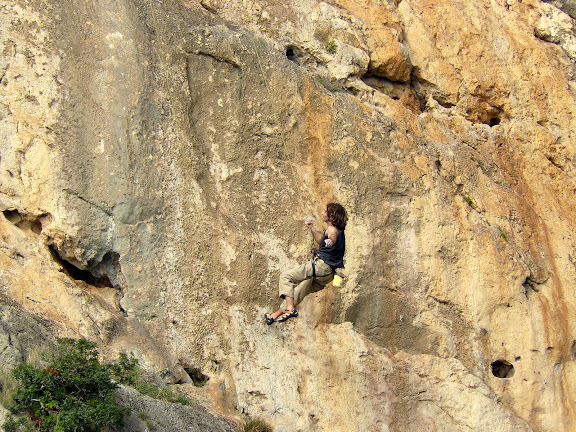
CLIMBING ON THE MYTHICAL ATLANTIS
CLIMBING IN SA PEDRERA D´ES SAVINAR
Of course the first quality of the climbers is not to have dizziness and then to be acquainted with all kinds of devices, strings etc, that it is necessary to go with it in order for the success of the climbing, specially the raise.
For those as me who not dare to rise, also inducement is to see all this from below, suffering with any incident that they can have in the heights for those who practise it.
Certainly after the difficult raise, the descent comes and this one is much simpler and certainly much more fast. For those who don´t practise climbing, our descent does not stay here, we lack much for going down up to the mythical Atlantis, also for us the way down will be faster. The raise on our way back and way up will be much harder.
December 19, 2009
ATLANTIS´s LEGEND
Thousands of years ago, here in this place a grand and prosperous City existed, with big buildings that still today we can see though demolished due to a great cataclysm that finished with this mass of land. For then the famous princess adored by her people was called Tanit, and later the history turned her into goddess, her father was the King of this place. The big marine monsters coexisted together with these people since they were never approaching excessively to the coast. But one day two enormous marine monsters came together with a smaller one. The big monster fell in love rapidly with the Princess Tanit and remained totally still in front of the City to be able to contemplate her to daily. The small monster remained slept to the feet of this one, and the third monster that was the mother of the small one, moved back very sadly up to the other side of this small sea, today it is possible to see as a rock in Calpe's locality, and it´s called "peñón de ifach ", and the other two, are there just infront here, the big one still looking where the Princess was strolling, and the small one rolled and still sleeping from then next to his father, they call " Es Vedrá and Es Vedrané " the time have converted them in to rocks, and the lost city little is under the sea except a small side where we can still see the remains of that great and prosperous former City.
Dad: tell it to me again. My son since we went down there many years ago, repeats incessantly the same thing whenever we go. Tell me again the history of the monsters and the lost City.
These big temples, did they exist indeed?, and these beautiful natural swimming pools?, actually they are there, and maybe the best thing it´s to remain with the magic of those legends...
The certain thing is that this place "atlantis" which is called "Sa Pedrera" (the real name) is a former quarry that the Romans were exploiting it already. Anyhow it seems that decades ago stone was extracted to do big blocks for some of the island´s harbours and marinas.
But still the certain thing is that there they are both crags, the two guardians of the Island. Es vedrá and es Vedrané observing this place. A place where we can disconnect of "our routine and stressing world ".